


How to always choose a rosé you’ll love
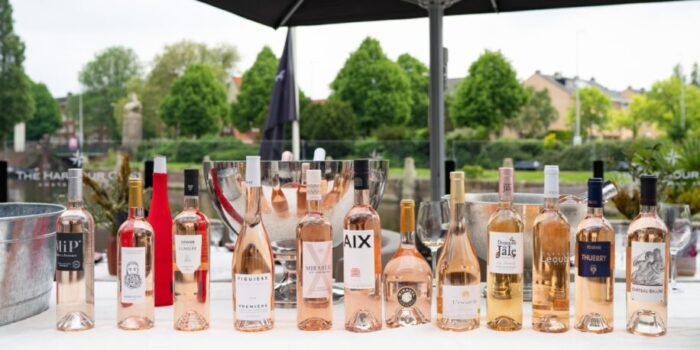
As soon as the sun starts shining, we open a bottle of rosé. Because no wine cries out for skirt day, terraces and the beach quite like rosé. But what kind of wine is it exactly, what differences are there between rosé wines, and how can you always choose a rosé you’ll enjoy?

Let’s start with the most important rosé fact….
Rosé from Provence
Provence is the largest (quality) rosé producer in the world. The region stretches for almost 200 kilometres between the Mediterranean Sea and the Alps. The landscape of Provence is incredibly diverse and enchanting, with lavender fields, olive trees, charming villages and, of course, the azure-blue Mediterranean Sea. And then there’s that beautiful salmon-pink rosé… we just love it – and we’re not the only ones.

Every year, more than 170 million bottles are shipped around the world! Famous Provence wines include MiP, Domaines Ott, Miraval (from Brad Pitt and Angelina Jolie) and Whispering Angel. And AIX and Fleur de l’Amaurigue prove that the Dutch also make delicious rosé in Provence.
Rosé can be made from different grapes; a total of no fewer than 18 (!) different grape varieties are grown in Provence. The three most important grape varieties for rosé wines are grenache, cinsault and syrah. In Provence, grenache almost always takes centre stage.
How rosé is made
Rosé gets its colour from soaking the skins, just as with red wine, of blue grapes in their own juice. The skin contact is simply much shorter than with red wine. The length varies by producer – and produces a spectrum of pink shades. The longer the skin contact, the more colour there is, and eventually a point is reached when the wine moves beyond the rosé stage and becomes a red wine.
Choosing a Provence rosé
Not every Provence rosé is the same. So how do you choose the rosé you’ll enjoy? We asked oenologist and wine writer Janna Rijpma, author of several wine books.
Janna: ‘Provence is above all the Grand Old Lady when it comes to its great diversity of terroir. Especially the three largest AOPs – Côtes de Provence, Coteaux d’Aix en Provence and Coteaux Varois en Provence – have so many different soils (limestone, volcanic soil, schist, sand, clay), surroundings (forests, mountains, sea) and therefore different weather conditions (no, it isn’t equally hot everywhere in Provence!), that no two rosés are alike.
There are also many family wineries and cooperatives, each with their own style. From fruity to mineral, or spicy, full-bodied and robust, or elegant and fresh.’

Will you go for a fruity or full-bodied rosé?
If you like floral, fruity, spicy and balanced wines, choose a rosé from Coteaux d’Aix en Provence. The area is characterised by many mountains and slopes, as well as high-altitude vineyards with white limestone soils. As a result, temperatures are slightly lower. AIX is a well-known example.
If you like an expressive and mineral rosé, look to Côtes de Provence. Because of the extensive landscape, the soil is a patchwork and therefore geologically quite complex. Two key elements in the soil are limestone and crystallline (white pebbles), which accentuate the fresh acidity in the wines. Fleur de l’Amaurigue is a well-known example. Whispering Angel is also made here.
And if you like a somewhat dry, fuller style, Varois-en-Provence is the answer. The region has a continental climate with greater temperature differences between summer and winter. This produces more expressive, full-bodied rosé wines. Miraval’s, for example.

Rosé from outside Provence
Because of the popularity of Provence wines, you might almost forget it, but rosé is also made extensively throughout the rest of France. In the Loire, for example, where Chinon and Anjou are the most popular rosés. In fact, rosé can and is made almost everywhere in the world; in well-known wine countries such as Italy (rosato) and Spain (rosado), Germany and the US, for example, and in lesser-known wine countries such as Croatia, Uruguay, Lebanon and Thailand. As long as blue grapes are planted.
Best when young
Some wines, such as powerful examples from Bordeaux and Burgundy, only become more beautiful (read: more complex) after spending years gathering dust in a dark cellar. Rosé, on the other hand, with a few exceptions, is best when very young. Crisp, fresh and fruity, and wonderfully juicy. So open that new bottle right away.
Also read:
- Restaurant Tannay in Amsterdam: classic French dishes on Realeneiland
- Bluff your way into: wine terms
- We bought vegan mozzarella and it turned out to be a bad idea
Images: Vivian Secreve (@photograviv)


