



How to make beurre blanc: this is how you do it
There aren’t many sauces that are as wonderfully rich and decadent as a good beurre blanc. But as tempting as this sauce is, you can also burn your fingers on it just as quickly. Figuratively speaking, that is. Just like sauce hollandaise, its preparation really comes down to technique and temperature control: the sauce must absolutely not get too hot. If you aren’t careful, the sauce will split in no time. Tobias Camman comes to the rescue!

Tobias: ‘I’ll readily admit that my first attempts weren’t exactly great either. Fortunately, after writing two previous cookbooks, I have quite a network of (star) chefs I can ask for help. After going through a number of their recipes, this is my own distillation. Yes, it contains cream; that’s not necessarily how it’s supposed to be, but it works better, is absolutely delicious, and some top chefs do it too. So…!’
Making beurre blanc: reducing, tempering, binding
- We start with the gastrique. This is basically reduced white wine with a few extra flavors added, so that’s what we’ll make. Pour the wine into a saucepan and add the vinegar, juniper berries, peppercorns, and cloves. Bring to a boil.
- Let it reduce gently until you have 50 ml of liquid left – this process is called reducing. Pour it through a sieve and discard the aromatics.
- Return the gastrique to the saucepan and set it aside for now.
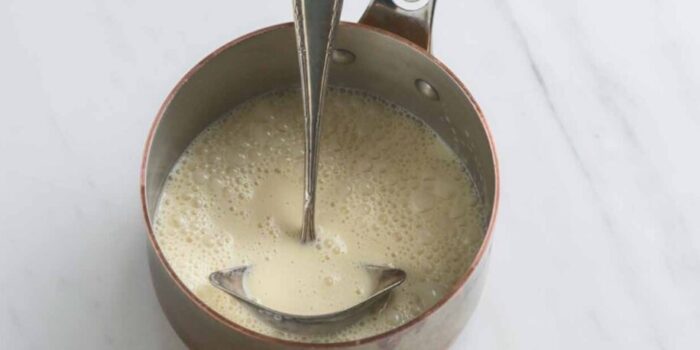
- Bring the cream to a boil in another saucepan over low heat. Let it reduce gently until only half remains (what you’re actually doing is allowing the water in the cream to evaporate so that you are left with a thicker substance).
- Pour the remaining cream into the saucepan with the gastrique. Place over very low heat.
- Meanwhile, cut the butter into dice-sized cubes and add them, one knob at a time, to the cream and gastrique mixture. As soon as one knob is almost melted, add another. At the same time, whisk continuously through the saucepan so that the butter melts evenly into the mixture. You are now tempering: keeping the sauce’s temperature below boiling point. As soon as the sauce gets too hot, it will split. Adding cold butter keeps the sauce cooler.
- Remove the pan from the heat when the last knobs of butter have been added. Keep stirring very well. Once the last knob of butter has melted, briefly use an immersion blender. This adds air, but also provides extra binding.
- If all goes well, you now have a beautifully bound beurre blanc. Add a little salt to taste if desired.
Pro tip
You’ll notice that the beurre blanc thickens as the sauce cools; that’s not a problem, because you can simply reheat it. But be careful: if the sauce gets too hot, it will still split and you’ll have to start all over again. Keep the beurre blanc around 60 °C and continue whisking and blending with an immersion blender while reheating. You’ve been warned.
Okay, one more tip: Visvoer
You’ll find this recipe in Tobias’ new book Visvoer. His cookbooks Voer and Groenvoer have already helped many aspiring food snobs create impressive, restaurant-worthy Christmas, birthday, and family dinners. What was still missing was a cookbook dedicated entirely to fish, in a sustainable way. And hooray, it’s here now!

Title: Visvoer (publication date: 31-10-2024)
Author: Tobias Camman
Price: €34,99
Publisher: Blossom Books Bold
Also read:


