



Italian Pasta versus Asian Noodles: What Are the Differences?
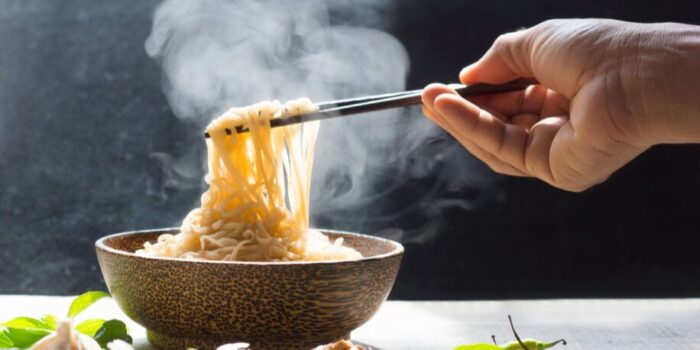
Why don’t we simply get the noodles for such a wonderfully steaming bowl of savory ramen from the Italian pasta aisle at the supermarket? And why don’t we make carbonara or pasta primavera with bami? In China, people have been cooking with noodles for thousands of years; in Italy, they have been eating pasta for centuries. But because of certain differences, they are not automatically interchangeable…

It would be pretty convenient, wouldn’t it, to have just one package of dried dough strands at home and use it to make everything from the aforementioned ramen soup to a large plate of steaming pasta with classic ragù? Um, in short: no! Because all these dough varieties have their own qualities, making them perfectly suited to one thing and less so to another.
The biggest difference
Right at the beginning, when the dough is made before it is dried and its shape is then determined, we can already see the biggest difference: the basis of the dough. Almost all Italian pasta, regardless of the shape it ultimately takes, is made from wheat flour. More specifically, durum semolina. Within that, there are still two schools: with egg and without egg in the dough.
Asian noodles, regardless of their shape, use an enormous variety of ingredients as the basis for the dough. Soba noodles are made from buckwheat, rice noodles from rice (duh), cellophane noodles from mung beans, and there are noodles made from sweet potato and regular potato. Asia also has many dough products made from wheat flour, including varieties with and without egg, just like Italian pasta.
Shape and substance
Once the dough has been made, its shape is determined. If you like dim sum, you have probably seen those beautiful rolled rice-dough wrappers, for example filled with meat. Or think of the folded triangles in wonton soup, or fried as pangsit. Noodles vary in thickness, and many countries have their own classic dish with a preference for a particular strand shape. Pad Thai should be made with thin, flat rice noodles, while Dan Dan noodles use a thin, round egg noodle. Read our extensive guide to buying noodles here.
And let’s see whether those Italian pasta shapes go beyond the spaghetti, tagliatelle, ravioli, penne rigate and farfalle (which you can use to make these amazing pasta chips!) that we are now used to finding in the supermarket (or better yet, get them from a top Italian traiteur). Ha! Absolutely! Ask a number of Italians, and the answer to the question of how many pasta shapes there are can range from 50 to 250. “Tortellini, tortelli and tortelloni, for example, are already three variations on the same theme, but in different sizes,” says chef Chris Barch of restaurant North Italia.
Which sauce goes with which pasta
With Italian pasta, that shape is also closely connected to the sauce it is eaten with. Of course, pasta varieties are sometimes swapped, but the principle is: sturdy pasta with robust sauces, such as pappardelle with that classic ragù, and lighter, thinner pasta with light, fresh sauces or ingredients, such as linguine or spaghetti with vongole. Short pasta varieties with ridges are perfect for capturing sauces. We tell you more in our guide, Which Pasta Goes with Which Sauce.
In short: if you love food as much as we do, it is wonderful to have a pantry stocked with many different types of noodles and pasta. Try something different every evening, from the simplest noodles with crispy chili oil and some spring onion to a delicious pasta with cavolo nero and burrata: what more could anyone want?!
Read also:


