


Keuringsdienst van Waarde investigates E460 (cellulose) in our food
You could easily think that ‘E460’ is the name of a newly opened highway or something. But no, it’s an E-number. It’s also known as cellulose. The bizarre thing is that this substance is also found in trees. Um… Does that mean there’s tree in our food?! Keuringsdienst van Waarde investigated what cellulose actually is. And just as importantly: what it does in our food.

The supermarket is packed with processed products. E-numbers are added to products to make them more aromatic, colorful, tastier and longer-lasting. But sometimes they’re also used to improve a product’s texture. That’s exactly why Coolbest, for example, adds E460—also known as cellulose—to its juices. Cellulose gives the juice a much thicker, more pleasant mouthfeel.
E460 extracted from wood
Okay, I’m getting ahead of myself. What exactly are E460 and cellulose? If you Google it, you’ll read that it’s a substance commercially extracted from wood. So it’s found in trees, because wood comes from trees. Forest ranger Jeroen Glissenaar confirms this. ”Without cellulose, a tree can’t grow, can’t remain sturdy and can’t be strong.” He compares it to reinforcing steel in concrete. Cellulose holds cells together, which keeps a tree—and, for example, your wooden cabinet—from collapsing. So it’s a crucial component of a tree.
From custard to diapers
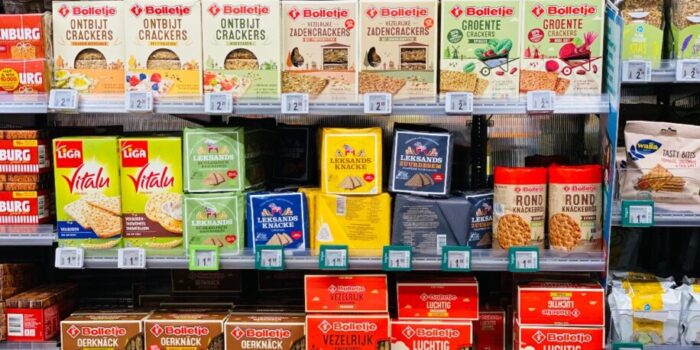
But cellulose can also be found in a great many supermarket products, if we’re to believe the packaging. Sausage, chocolate milk, falafel, crackers, custard, goat cheese and even diapers: they all contain cellulose. So that means these products contain cells from trees. ”If there’s cellulose in this, then there’s tree in it,” says forest ranger Jeroen, pointing to the pile of products in front of him.
Thick texture
The question is: why would you add cellulose to your product? Coolbest adds it to its mango-orange fruit breakfast drink, the version with less sugar. They mainly do this to make the product thicker and fuller. It simply makes for a more pleasant drink. You can see the addition of cellulose with the naked eye. Put a glass of juice with cellulose next to one without it, and the version with cellulose is clearly thicker in texture. It creates a firmer binding in the product. Exactly what cellulose also does with cells in trees.
The effect of cellulose may be even more visible in goat cheese balls. You know, those little balls you can add to your salad. The cellulose keeps the goat cheese balls in shape. Without this ingredient, they would fall apart ”like dry falafel.”
Cellulose as dietary fiber
Cellulose has another function: it’s a dietary fiber. That’s why the packaging of products containing cellulose often states that they’re a ‘source of fiber.’ But what’s crucial is that you can actually add cellulose, or E460, to your product. That means you can suddenly turn a pizza into a source of fiber. We also see this in the Keuringsdienst van Waarde episode, which visits a German manufacturer that extracts cellulose from wood. The factory makes those fibers for food products. We even see that a salami pizza with a Nutri-Score E suddenly gets a Nutri-Score B by adding cellulose.
According to Marcus Zott, an employee at the German fiber factory CFF, it’s better to eat products that naturally contain fiber. Apples and bananas, for example. But ”who even eats fruit these days?” he says. ”People eat processed food, such as pizza and pasta, and those don’t naturally contain any fiber.” So they add it at the factory, allowing people to maintain their unhealthy lifestyle while still getting fiber.
Conclusion
In short, should we be worried? No, cellulose isn’t necessarily bad for us. Of course, we can choose products without E-numbers, and cellulose is an E-number after all. But is it realistic to eat completely free of E-numbers? Opinions differ. What you should bear in mind is that the bold claim of ‘SOURCE OF FIBER!’ on your product’s packaging probably comes from the addition of cellulose. Yes, you do get fiber when you eat a pizza. But your pizza isn’t suddenly very healthy, even if that Nutri-Score B on the packaging might suggest otherwise.
Also read:
- Drain cleaner in your olive?! Keuringsdienst van Waarde shows you
- Keuringsdienst van Waarde shows: this is what’s in your supermarket cheese (and it’s not good)
- Keuringsdienst van Waarde investigates: these 10 supermarket products contain the most sugar
Source: Keuringsdienst van Waarde/NPO


