



More than 15,000 restaurants in Germany at risk of collapse
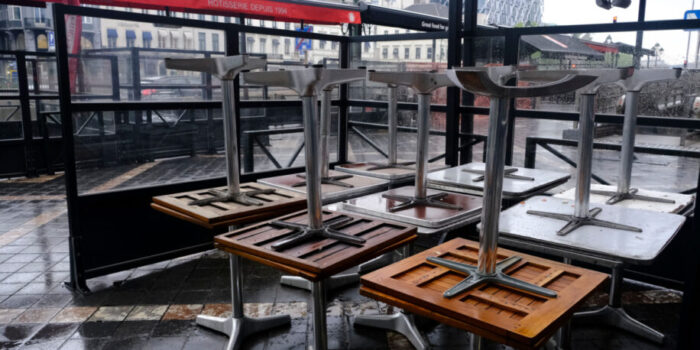
The German hospitality industry is not doing well, and that is quite an understatement: things are simply very bad, and 2024 already threatens to become a disastrous year. The financial problems restaurants are facing are only getting worse, and as a result, a record number of hospitality businesses are at risk of going under next year: people are talking about 15,000 businesses that do not appear likely to survive. And that is also a major concern for the Netherlands.

120,000 hospitality businesses were examined by German information services provider Crif, and they arrived at this result.
Increased VAT rates create even more problems
On 1 July 2020 — in the middle of the coronavirus pandemic — the German government reduced VAT rates for restaurants and cafés from 19 percent to 7 percent, in order to ease the burden on the hospitality industry. However, this scheme ends on 31 December 2023, which means that all hospitality businesses will once again have to pay 19 percent from 1 January 2024 — and as things currently stand, around 15,000 businesses will be unable to cope with that.
But that is not the only problem facing the German hospitality industry: there is also a staff shortage, and businesses are suffering from lower revenues than before (pre-Covid). ‘Margins are tight, everything has become more expensive and people are spending less money in the hospitality industry. It is a concrete example of the financial problems many German entrepreneurs are dealing with,’ says Germany correspondent Derk Marseille.
Because of these problems, a number of proposals were included in the German 2024 budget; for example, extending the reduced VAT rates for longer. Unfortunately, nothing came of it. Marseille: ‘We have known since the ruling by the Federal Constitutional Court that there is simply no room for this in Germany. That is why the sector is in danger.’
That sounds familiar
Do those financial problems in the hospitality industry sound familiar? Yes, that may well be the case; because things are not exactly going well in the Netherlands either. Here too, we are still dealing with staff shortages and higher costs. After all, the employees you do have are asking for a higher salary than before — a case of supply and demand. If you do not offer it, they can get it somewhere else. On top of that, inflation is also hitting hard, and profit margins are shrinking considerably.
According to an Amsterdam hospitality business owner we spoke to about this, it is difficult to pass on all the rising costs in the menu; you do not want to scare your guests away from your business because of sky-high prices. And that is while, if you calculated it correctly in terms of margins, a beer should by now cost 4.20 euros. For a small glass!
And besides the rising costs and tighter margins, another problem is looming: the tax debts from the coronavirus period also have to be repaid. This could also become a major problem in the Netherlands, if it is not already one — in the first half of this year, there were already 50 percent more businesses for sale than usual.
Germany goes, the Netherlands follows
It is also the case that the Netherlands often follows Germany as ‘the example’. Germany and the Netherlands are economically highly intertwined, and should the hospitality industry there truly fall into a crisis, there is a very good chance that we will follow. Unfortunately, this also means that hospitality businesses in smaller villages and towns in particular are likely to be affected; cities such as Amsterdam, Rotterdam and Utrecht still attract plenty of tourists, and people have by now become accustomed to the high prices (and probably have more to spend as well).
Fortunately, nothing is certain by any means, but 2024 could well become a very difficult year for both the German and Dutch hospitality industries.
Read also:
- These 15 restaurants were awarded a green Michelin Star by Michelin
- Take your salad to Michelin-star level
- These lava cakes have a Michelin star and you can now buy them to enjoy at home
Source: BNR


