


Pastéis de nata: how to make these delicious pastries yourself
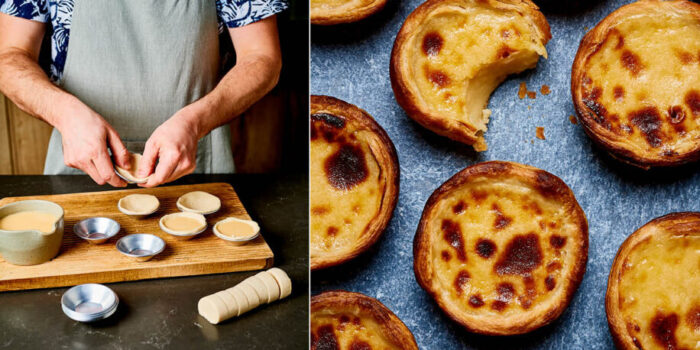
Heel Holland Bakt winner Rutger van den Broek keeps happily baking away. Not only Dutch pastries, but also treats from all over the world. From Indonesian pandan cake to these Portuguese pastéis de nata; in his new book De Bakatlas, he shows you how diverse baking is in different countries and how you can do it yourself at home.

Rutger: “The official recipe for these Portuguese tarts is a closely guarded secret, but after a number of baking sessions I managed to get very close. It is especially important that the pastéis de nata are baked briefly at a high temperature. Unlike all the other recipes in this book, I therefore bake these using convection heat. If your oven can get hotter than 250 °C (preferably around 280 °C), definitely give that a try. Do bear in mind that the baking time will then be slightly shorter. The pastéis bake best in special moulds, but you can also bake them in a cupcake tin. The special moulds taper slightly more, which gives them a subtly different shape. They are also very thin and conduct heat especially well.”
How to make the pastéis de nata
- Preferably make the filling and the dough a day in advance. For the filling, use a vegetable peeler to remove the peel from a quarter of a lemon and place it in a saucepan together with the milk and cinnamon stick. Bring the milk to the boil, remove the pan from the heat and leave the milk covered with a lid or plastic wrap for 1⁄2 hour.
- Mix the sugar with the flour. Strain the milk and bring it to the boil again. Add the sugar mixture while stirring and let the milk thicken slightly over low heat for 1–2 minutes. The mixture does not need to boil again. Remove the mixture from the heat and let it cool to body temperature. Beat the egg yolks into the mixture and leave it covered with plastic wrap to rest overnight in the refrigerator.
- For the dough, mix the flour with the salt in a bowl. Cut the cold butter into cubes of approximately 1×1 centimetre and toss them through the flour with your fingertips. You do not need to knead. Add the water and mix everything until combined. You still do not need to knead; the idea is for the cubes of butter to remain intact in the dough. Wrap the dough in plastic wrap and refrigerate it for 1⁄2 hour.
- On a floured work surface, roll out the dough into a sheet of approximately 25×12 centimetres. Because there are lumps of butter in the dough, you need a little more flour on your work surface for rolling it out than you would normally use. Fold the dough into thirds, like a letter. Turn the dough a quarter-turn and roll it out in the other direction, again to 25×12 centimetres. Fold this piece of dough into thirds again. Wrap the dough in plastic wrap and let it rest for at least 1⁄2 hour.
- Roll out the dough into a square of approximately 22×22 centimetres. Moisten the dough slightly with water and roll it up tightly. Wrap it in plastic wrap and let it rest in the refrigerator for another 1⁄2 hour.
- Preheat the oven to 250 °C on the convection setting.
- Cut the roll of dough into 12 equal slices. Place one slice of dough flat on the bottom of each mould and press it out with a wet thumb until the entire mould is covered with a layer of dough. Fill the moulds with the milk mixture to 1⁄2 centimetre below the rim. Bake the pastéis de nata for 13–17 minutes. Remove them from the moulds after baking and place them on a wire rack. Serve them warm (or lukewarm) or cooled, and dust with icing sugar if desired.

Title: De Bakatlas
Author: Rutger van den Broek
Price: €35
Publisher: Carrera Culinair
Also read:
- How to make Bossche bollen yourself
- How to make the most delicious tompouces yourself
- Recipe: sticky banana cake with syrup sauce


