


Putting your plastic water bottle in the dishwasher? Don’t – here’s why
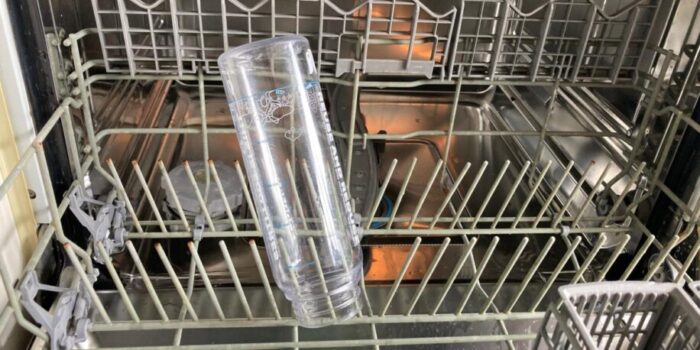
I recently came to the embarrassing conclusion that I hadn’t cleaned my plastic water bottle in far too long. Tomorrow I’ll really put it in the dishwasher—that’s the thought that crosses my mind every morning. What do you know? My laziness is (sort of) rewarded. Research by Tegengif shows that putting your plastic water bottle in the dishwasher is actually very unhealthy for you.

That has everything to do with the substance DiBP. It can cause quite a bit of damage if you ingest too much of it. Consumer affairs program Radar revealed exactly how this works.
Shocking
The Radar broadcast focuses on research by Stichting Tegengif, carried out by Canada’s McGill University. The organization examined 39 reusable plastic water bottles from the Netherlands, Denmark, Spain, the Czech Republic and Lithuania. All bottles were put in the dishwasher twice a day for ten days. The conclusion was that DiBP was found in more than half of those bottles (read here the responses Radar requested from various brands). And that’s shocking, to say the least.
Endocrine-disrupting substance
Why? Because DiBP is an endocrine-disrupting substance. It is a harmful plasticizer. The fact that it is a plasticizer can be seen, for example, in the fact that you can squeeze in some plastic bottles. DiBP can particularly disrupt hormone balance in men. It has “an inhibitory effect (…) on the production of the male hormone testosterone,” says Jorke Kamstra, assistant professor of endocrine-disrupting substances at Utrecht University, to Radar.
Animal studies have not produced particularly pleasant results. Deformed urethras and undescended testicles, for example. And “effects on the reproductive organs have also been found in humans,” Kamstra says.
Not in the dishwasher
The substance DiBP is released when plastic water bottles are put in the dishwasher more frequently. This was shown by a chemical test of the water left in the bottle after washing. The substance was not found in 39 other bottles that were washed in a different way, rather than in the dishwasher. So how is it that this substance is released specifically during dishwasher cycles?
Annelies den Boer, chair of Stichting Tegengif, thinks this is partly due to the high temperatures at which the bottles are washed in the dishwasher. She also believes that the force with which water is sprayed against the bottles in the machine may cause the chemicals to come loose.
The future
Besides DiBP, around 300 other unknown substances were found to be released into your plastic water bottle after a dishwasher cycle. A rather scary thought, right? That you simply don’t know what you’re ingesting. Whether anything will change in the legislation surrounding plastic water bottles remains to be seen. Officially, adding the harmful plasticizer DiBP to food-contact products is not permitted.
Because DiBP is used so extensively in the production of plastics, the EU nevertheless accepts that the substance is present in those plastics. It also accepts that DiBP may leach from plastic into food up to a certain concentration. Stichting Tegengif disagrees. In its view, that limit should simply be zero. No DiBP in those water bottles at all, in other words. Politicians are also advocating for this. There is hope for change in the future, especially because science is becoming increasingly clear about the dangers of DiBP.
But the chemical producers have a strong lobby. To be continued, then. So what can we consumers do now? Throw your plastic water bottle in the trash—or at least get over your laziness and clean the thing by hand.
Note to self: tomorrow I’m really going to do it.
Also read:
- Huh: are those expensive bottles of water filled with ordinary tap water?
- How to give your dishwasher a truly thorough clean
- What to eat when you’re having a f-ing awful day
Sources: Radar, StichtingTegengif


