


Rabbit meat from supermarkets must have at least one Better Life quality mark star next year
It’s an annual feature on the Christmas dinner table: rabbit. Many people find it (too) sad, while others consider it quite fitting around the holidays. But did you know that supermarkets still sell rabbit meat from rabbits that lived in terrible conditions? That will come to an end in the coming year.

There are a few supermarket chains that sell rabbit meat without a single star from the Better Life quality mark. Lidl is one of them, which is remarkable because Lidl is often a frontrunner when it comes to sustainability. Their three-star cheese is excellent, and they also sell Kipster eggs, from a company that, according to the Wakker Dier Foundation, excels in animal welfare and sustainability. But Wakker Dier is less enthusiastic about the rabbit issue…
‘Animal suffering of the worst kind’
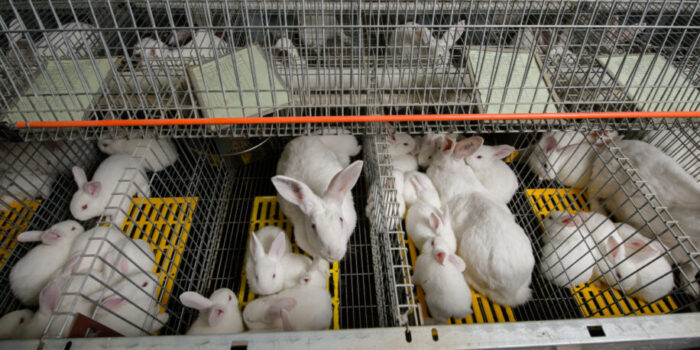
Rabbit meat without a star is also still available at Jan Linders and Nettorama stores. (Incidentally, the Jan Linders chain will disappear in the near future, and most of its stores will apparently become Albert Heijn locations.) Anne Hilhorst, director of Wakker Dier, says: “Rabbit meat without a star means animal suffering of the worst kind. You don’t put that on the table to celebrate.” The animals used for this are called ‘suffering rabbits’ by the animal welfare organisation.
Locked up with their young
“They live in plastic cages with wire mesh, with around 13 animals per square metre. Contrary to their social nature, mother rabbits are locked up alone or with their young in small cages. The wire mesh flooring often causes inflammation in their delicate paws,” says Wakker Dier.
A star next year
But before Christmas 2023 arrives, the supermarkets that currently sell it will no longer stock rabbit meat without a Better Life quality mark star. The (single) star from the Dutch Society for the Protection of Animals’ quality mark will indicate that at least better housing has been provided for the mother rabbits, and that the floors of the (more spacious) enclosures are largely made of plastic, helping to prevent injuries.
Source: Levensmiddelenkrant
Also read:
- Can we stop selling food in the shape of Christmas trees?
- Types at the Christmas dinner table
- You’ll want this: the wine-bottle Christmas tree


