



Sushi without fish: how to make the tastiest VEGAN SUSHI
When people think of Japanese cuisine, they often think of sushi, Wagyu, yakitori and fresh tuna. But Tim Anderson, the ultimate expert on Japanese cuisine, shows that Japanese cuisine is actually based on many plant-based dishes. In his book Vegan JapanEasy, he teaches you how to stock a Japanese pantry and use essential flavorings such as miso and dashi for delicious snacks, ramen, noodle and rice dishes. And he tells you how to make the tastiest vegan sushi!

Tim: “‘Vegan sushi’ is one of those terms that makes the hairs on the back of my neck stand up. I automatically react irrationally and negatively to it, and when someone says it, I want to knee them and run away fast. This is because, in my opinion, sushi simply can’t be vegan – it’s all about the fish, isn’t it?”
“Sushi chefs probably get annoyed by ‘vegan sushi,’ or at the very least have a chuckle about it. But for this book I tried and tasted many kinds of vegan sushi and am convinced that it can genuinely be delicious, with the same colors, textures and flavors you find in traditional fish sushi. I may be a sushi snob, but even I have to admit that the following recipes make really tasty little bites – which also look beautiful.”
The rice
Sushi rice may be the most important component of vegan or any other sushi. It may take a while to get the hang of it, but if you follow this recipe, you can make rice that is really pretty good, and definitely better than most ready-made sushi you find in supermarkets and sandwich shops.
The texture
Sushi rice should be firm but of course not chalky, and never mushy. Follow the recipe below and the rice will be perfectly cooked, but remember that how you handle the rice also affects the texture. When mixing the flavorings into the rice, use the cut-and-fold method instead of digging into the rice, and when shaping your sushi, don’t squeeze it as if you want to strangle it, but use just enough pressure to make everything stick together.
The temperature
One of the worst things about store-bought sushi is that the rice is far too cold. This makes the sushi hard (unless the rice was already overcooked) and it doesn’t do the flavor any favors either. Sushi rice should be at body temperature, or just slightly warm – think of sushi as an open-faced sandwich: carbohydrate-free toppings on a carbohydrate-rich base. Surely you would never make a sandwich with chilled bread straight from the refrigerator – that’s just weird and unpleasant.
The flavorings
Sushi rice should be seasoned with plenty of sushi vinegar while the rice is still hot, so the grains can absorb the sushi vinegar properly. Yes, you’ll eat the sushi with delicious garnishes and soy sauce later, but the rice itself should also be wonderfully sour and salty.
How to make perfect sushi rice
Tim: “The first time you make sushi rice, it may not be perfect (or perhaps never, let’s be honest), but the good news is that it doesn’t have to be perfect – good is good enough. Here’s how to make good sushi rice.”
- You need about 75 grams of rice per person – or 100 grams if rice is the main ingredient (as with fried rice or rice bowls), but if you’re making rice balls or aren’t very hungry for carbohydrates, 50–60 grams per person is enough. It’s better to weigh the quantities – a scale is more accurate than measuring volume, and you can weigh it directly in the pan.
- Weigh the rice in the pan and wash it: fill the pan with water, move the grains through the water, massaging them a little as you do so, and pour the water out of the pan. Do this three or four more times. This removes excess starch that would make the rice sticky (the starch is essentially rice flour, so when you cook it, it turns into a kind of glue).
- Pour the measured amount of water into the pan and stir briefly so that the rice is distributed in an even layer across the bottom. If you have time, let it soak for 15 to 30 minutes; this helps the rice cook evenly. No time? No problem – unsoaked rice will still be delicious.
- Place the pan uncovered over high heat and bring to a boil. Put the lid on the pan and turn the heat down – perhaps not all the way down, because the water needs to keep boiling, but fairly low. You should be able to hear the rice cooking and let it steam for minutes. Don’t lift the lid to check how the rice is doing – it’ll be fine! When the timer goes off, turn off the heat.
- Once the rice is cooked, spread it out over a large, flat plate or in a roasting tin and sprinkle the sweetened vinegar and sea salt over it. Mix the vinegar and rice with a rice paddle or spatula using a cutting-and-turning motion. Let the rice cool slightly, transfer it back to the pan in which you cooked it and put the lid on so the rice stays warm until you use it.
Makizushi
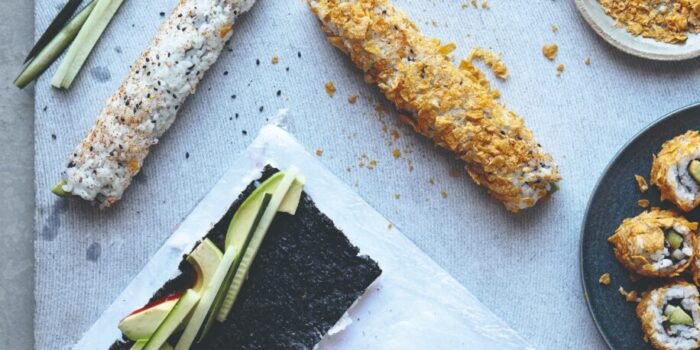
Okay, time for rock ’n’ roll. Makizushi, or sushi rolls, are usually the best option if you’re looking for vegan sushi. Pickled vegetables or other crunchy vegetables are often used to create a pleasant textural contrast with the rice. But I think we can come up with something better than cucumber and dried gourd. The recipe below for a spicy avocado sushi roll is the tastiest sushi I’ve ever eaten – you really won’t miss the fish.
For each sushi roll (which makes 6 pieces of sushi), you need 100 grams of cooked rice (from 50 grams of uncooked rice), half a sheet of nori and a bowl of water. You also need a piece of paper wrapped in several layers of plastic wrap. Yes, really. (You can use a sushi mat if you have one, but if not, I’d only buy one if you’re going to make sushi regularly.)
How to make a spicy avocado sushi roll
This recipe makes 3 rolls, or 18 pieces of sushi, using 300 grams of cooked rice – half the amount in the sushi rice recipe above.
Ingredients:
1.5 sheets of nori
1⁄2 recipe prepared sushi rice
squeeze of sriracha
flesh of 1 avocado, cut into 1 cm strips
1⁄4 cucumber, cut into long strips no more than 3 mm wide
about 100 g cornflakes, crumbled
a few pinches of shichimi
- Place half a sheet of nori on the paper wrapped in plastic wrap. Wet your hands with water, shake off the excess water and spread one-third of the rice over the nori, all the way to the edges.
- Now turn the nori and rice over so that the rice is on the bottom. Spread a little sriracha along the bottom edge of the nori, about 1 cm from the edge, and place a line of avocado and cucumber on top.
- Use the paper to lift the edge of the nori over the filling. Press the avocado and cucumber into the roll with your fingertips as you roll it up tightly, applying a little pressure. When you reach the other side of the nori, press the roll closed.
- Roll the entire sushi roll through the cornflake crumbs and shichimi just before serving. If you do this too far in advance, the cornflake crumbs will absorb moisture from the rice and the crunchy coating will become soft. So if you’re making different kinds of sushi, make this one last! Place on a cutting board and cut into 6 pieces with a sharp, wet knife. Make 2 more rolls in the same way.
Read also:
- ULGH! You really don’t want to know this if you love sushi
- Festive and delicious: the sushi donut
- 11 sushi dishes you really don’t want to try


