


Tasty Grape #3: Riesling

There are thousands of different grape varieties, and every year more are added through new crossings or (re)discoveries. Which grapes should you really get to know? In the ‘tasty grape’ series, I share my favorites, along with wine tips. This time: riesling. The wonder grape with its singing acidity, low alcohol content and variety of styles.

And what better day to honor this wonderful grape than today? March 13 is Riesling’s birthday: on March 13, 1435, Riesling—the wine named after the grape of the same name—was officially mentioned for the first time in Germany, on a purchase deed. That was no less than 586 years ago!
Monks’ work
Once, when German monks realized they couldn’t compete with French red wine, they made a wise decision. They devoted themselves to their own white riesling. Little by little, from the Middle Ages onward, the grape conquered the land of our eastern neighbors. By the 18th century, there was no stopping it. German Riesling was impossible to keep off European tables—and by the middle of the 19th century, Riesling was, alongside the finest red Bordeaux, one of the most expensive wines in the world.
Liebfraumilch
Then things went wrong. Grape diseases, wars and crises put an end to Riesling’s rise—and to that of wine in general. And while Bordeaux recovered relatively quickly after the wars, Riesling had a harder time. The image of German wine was thoroughly ruined by tsunamis of cheap, sweet plonk (think: Liebfraumilch). The resulting reputational damage was of epic proportions. German wine in general, Riesling included, fell completely out of favor.
Riesling renaissance
It wasn’t until the 21st century that the wonder grape resurfaced. By now, winemakers all over the world are in love with riesling. It is (almost) as much of a favorite as chardonnay and sauvignon blanc, and there is no self-respecting wine-producing country where riesling is not planted. Germany is still at the top, with approximately two-thirds of all riesling worldwide planted there. After Germany and Alsace (in French: Alsace), Riesling is also well known and loved in Australia.
Recognizing the style
Wherever it comes from, Riesling is characterized by a high degree of freshness. In general, Rieslings have a floral aroma and taste of apple, lime and peach, but also honey, spices and raisins. The sweeter the wine, the more exotic the fruit. If you’re up for an adventure, choose an older Riesling and enjoy marzipan, biscuit and the scent of petroleum.
Petrol heads
Petroleum? In wine? Whattup?! Yes, it’s quite a point of debate in the wine world. It used to be commonly said that this ‘goût de pétrole’, as the French affectionately called it, belongs to Riesling just as much as its high acidity. These days, plenty of winos claim that this pronounced flavor doesn’t belong in the wine at all. The typical petroleum aroma has everything to do with a compound (if you really want to know: 1,1,6-trimethyl-1,2-dihydronaphthalene), and as so often, the truth lies somewhere in the middle. Either way, you’ll smell it immediately if your wine has this ‘goût de pétrole’—and do say it out loud, in wonderfully French fashion, to your fellow diners; they’ll be astounded by your unrestrained wine knowledge! Whether you find it delicious (with petrol heads as its true fans) or unattractive? See for yourself! It has nothing to do with quality—or the lack thereof.
The riper, the sweeter
In Germany, Riesling ranges from bone-dry to absurdly sweet styles. But don’t be fooled: thanks to the tingling acidity, even the super-sweet varieties are often incredibly alive and kicking. Think you don’t like sweet wine? Then you should definitely try an Auslese, Beerenauslese, Trockenbeerenauslese or Eiswein: a titanic battle between sweet and sour, flavors and aromas with the precision of molecular cuisine.
Classification of wine types
Depending on the harvest date, German wine types are divided into classifications, increasing in sweetness. The last two are so rare that they are actually only sold in small bottles.
Kabinett: light, elegant wine with low alcohol content
Spätlese: elegant and powerful wine with pronounced fruit aromas, made from grapes harvested later
Auslese: sweet, fruity wine made from fully ripe grapes
Beerenauslese: sweet wine made from overripe grapes
Eiswein: made from frozen grapes harvested and pressed at a minimum of –7°C
Trockenbeerenauslese: very elegant sweet wine made from raisin-like, shriveled grapes.
What do we eat with it?
There is a Riesling for everyone. From light, taut and mineral to full, round and floral. And at the table, it can go in every direction too. You can never go wrong with fish. Dry (fuller-bodied) Riesling is delicious with sauerkraut, poultry, seafood and pork. The fresher Riesling tastes even better with light fishy bites and asparagus. Subtly sweet Rieslings are amazing with Asian food. The subtle sweetness cools the heat. Truly sweet Rieslings pair incredibly well with apple/pear tart, pineapple and white chocolate. But on their own, they may just be the most exciting dessert imaginable!
Serving you: three knockout wines, increasing in price.
Yalumba, The Y Series Riesling 2018, Australia, € 10.95
This is exactly the kind of Riesling you could drown in from sheer happiness. With that heavenly, fresh citrus aroma, combined with tropical fruit and lovely juiciness. As if spring were almost here. It’s a true terrace wine that you open at four o’clock and finish before you know it. Quick, take the next screw cap off. It’s also excellent with food; a salad with salmon or smoked trout, for example. Or a Waldorf salad with crisp apple. Also perfect with shrimp croquettes, grilled chicken or (mild) curry. Prefer lobster? Ooh la la, getting fancy, but it certainly works.
Weingut Markus Molitor, Haus Klosterberg Riesling Trocken, 2017, Germany, € 15.95
Delicious Riesling with those wunderschöne, crackling-fresh riesling acids. You taste and smell peach and pineapple, with something spicy too. Fresh and tart. Juicy and soft. And although most wines you buy are intended for immediate consumption, you can easily let this one rest for a while—if you’re a (respect!) patient and disciplined type. And here I come straight away with another of Riesling’s super powers: its aging potential. I, with my half a backbone, would say: just open it and order some sushi with it.
Muré Riesling ‘Calcaires Jaunes’ 2016, France, € 19.95
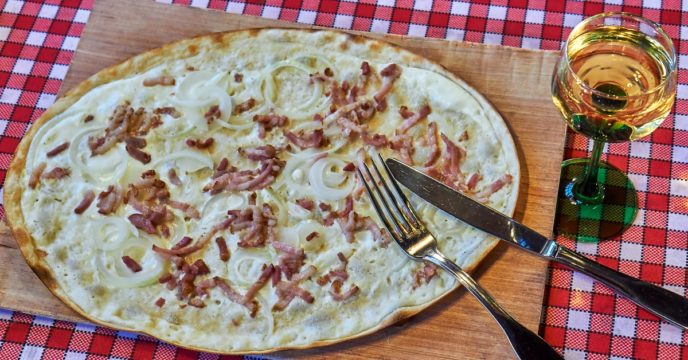
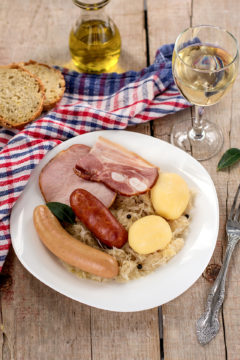
Floral organic Riesling with, there it is again, lovely acidity. Bring on that flammkuchen! Or, just as typical of Alsace, where this wine comes from: choucroute. A sauerkraut dish of mythical proportions, piled high with fish, pork and goose, sausages, cured pork belly, poultry, game and potatoes. When made well, the dish simmers—for hours—in Vin d’Alsace, naturally!—and then you drink a heavenly Riesling like Muré alongside it. Alsace is kitschy and cozy, Hans & Gretel-ish, but you can drink wonderful wine there and eat extremely well. Really worth visiting sometime. Better loosen your belt by one notch.
Also read:


