


This is the absolute best way to make pesto
Throw the food processor out the door and take the immersion blender to the thrift store, because the absolute best pesto is made with a mortar and pestle. Culinary editor Ella Quitner conducted extensive research and tried out several recipes, and this is her conclusion: the mortar-and-pestle method rules.

Oh sure, I think when I read in a cookbook that you should make pesto with a mortar and pestle, and I pull out my food processor. Back when pesto was invented, there simply wasn’t a Magimix yet, and those Italian nonnas are so deeply conservative that they would never allow a plugged-in appliance in the kitchen. My pesto is perfectly fine: I always throw all the ingredients into the blender jar at once and hey presto, within a minute the whole kitchen smells of basil and garlic.
Capo di tutti i capi – when it comes to pesto
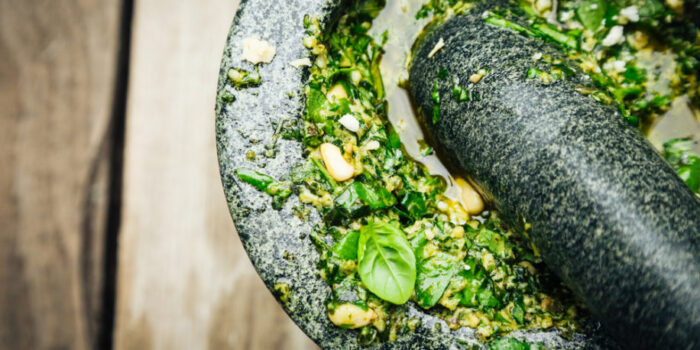
But culinary editor Ella Quitner (Food52) gives me—with words—a stern rap on the knuckles. She researched different ways of making pesto, and her conclusion leaves no room for doubt: it has to be made with a mortar and pestle. Quitner spoke with the godfather of pesto, Maurizio Valle. He is 77 years old and makes pesto about a hundred times a year. He shows her how he does it: first the garlic with some coarse salt, then the basil. Once the basil has been finely crushed (using circular motions, Valle instructs), the pine nuts can be added, followed by the Parmesan. The pesto padrino stirs in the olive oil at the very end, with a spoon. Ella notes that this method really allows the olive oil to be absorbed by the pesto and gives it a wonderfully smooth texture with a strong, fresh basil flavor.
Food processor: disaster!
When she gets to work in her own kitchen, she tries the food processor. A disaster, she says. You need a lot of ingredients before the blade can chop properly (and pine nuts aren’t exactly cheap), and the pesto’s texture isn’t evenly smooth. No, then there’s the immersion blender: that is Quitner’s great surprise. The result is almost as good as the mortar-and-pestle pesto—a major surprise! She does work in stages, though, so not—as I do—everything into one container at once and then aggressively run the blender through it, but garlic first, then basil, then pine nuts. Apparently, that’s important.
Sore muscles and chunky pesto
Don’t have all those complicated kitchen gadgets at home? You can also make pesto with a kitchen knife or a mezzaluna, a curved knife for chopping herbs. Apart from sore muscles, that doesn’t produce much, according to Quitner’s conclusion. The pesto remains chunky, no matter how long you chop. If you like chunky pesto, go ahead and chop and slice for twenty minutes. But for perfect pesto, the knives can stay neatly in the drawer.
The mortar and pestle is the best
In short: buy a mortar and pestle! First, mash a clove of garlic into a purée with a generous pinch of coarse sea salt. Add three handfuls of basil leaves. Young, light-green basil is especially good, if you can get hold of it. Then add three tablespoons of untoasted pine nuts and rub them in with the mortar and pestle. The cheese goes in with the mortar and pestle too—Quitner uses a generous handful of grated Parmesan and a generous handful of grated pecorino. Then the olive oil: no more than 60 ml of good extra-virgin olive oil, which she recommends stirring in with a spoon, following the maestro’s advice.


