


This is what we ate in the 2000s, part two
Going out to the wok palace or wokking at home, fiddling around with tiny herbs and the first-ever third Michelin star in the Netherlands. Let’s refresh your culinary memory of the 2000s. Also check out part 1, packed with eierkoeken and Schijt Aan Sonja.

Unlimited wokking
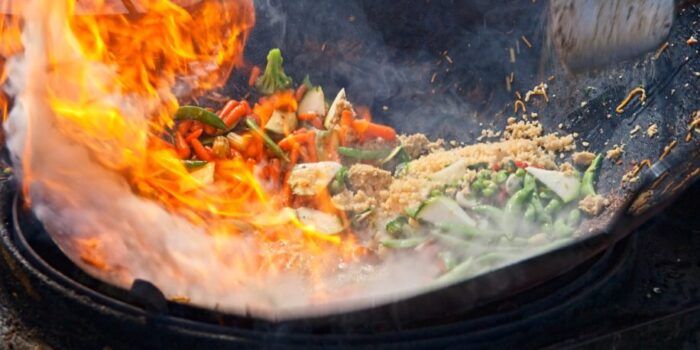
The regular nasi-complete-foe-yong-hai-Chinese restaurant suddenly turns into a wok palace. Your trusted Lotus or De Lange Muur is closed for a few weeks because it’s undergoing some serious renovations (what’s wrong with that suspended ceiling and those red lanterns?), and suddenly there’s a buffet instead of a little ordering hatch, the chefs have been pulled out of the kitchen and planted behind a hot plate, and you have to queue to have prawns cooked in sweet-and-sour sauce. Unlimited food, as much as you want—or at least as much as you can eat in a few hours—and there isn’t a trace of babi pangang to be found. Unfortunately, the wok palace is the big trend of the 2000s.
Wokking at home too
Don’t feel like standing in line behind the Tokkie family at the wok place? Then buy a wok at Blokker, like everyone does in the 2000s, get some wok sauce at the supermarket and throw in a bag of wok vegetables and sliced chicken. Wok vegetables, you ask? That’s just soup vegetables with bean sprouts, so wonderfully exotic. Wokking is absolutely the thing, and people having their kitchens renovated choose a stove with a wok burner that can produce an extra-high flame to achieve that unique aroma of Chinese flame-in-the-pan (and-in-the-extractor hood).
140,000 crates a week
A sad development: in 2002, the Netherlands’ first food bank opens in Rotterdam. Founders Clara and Sjaak Sies themselves predict that the food bank will only be temporary, but unfortunately, there are still 169 food banks where 140,000 Dutch people collect a crate of groceries every week.
Cress, but make it chic
A green sprig, a purple leaf or a bright yellow flower bud: from 2002 onward, mysterious little plants conquer Dutch restaurants. This is cress, comparable to the garden cress everyone grows on cotton pads in kindergarten, but made from different seeds. Brilliantly marketed by Rob Baan, the man who took over the company Koppert Cress in 2002. Since then, every self-respecting restaurant has had trays of different cresses in the kitchen (think: little vegetable gardens, but not withered).
There’s the third star
For the very first time, a Dutch restaurant receives a third star. At Parkheuvel in Rotterdam, Michelin’s plaque can be screwed onto the façade. Chef Cees Helder is as proud as a monkey with seven tails: “I dare say that I belong to the top of the country,” he says about his award to NRC. Michelin itself remains noncommittal; just as with other three-star restaurants, they find the food at Parkheuvel ‘very tasty’, according to the jury report.
Steak, very well done
No, the royal hospitality industry isn’t happy about that: enthusiastic home cooks push the sofa aside, add a few extra chairs and another little table in the living room and voilà, their living-room restaurant is open. Are you drinking cheap supermarket wine with complete strangers at a wobbly folding table over a slightly overcooked steak at the weekend, or enjoying a charming eight-course dinner at an unexpected location? Anything goes. Amsterdam’s oldest living-room restaurant, Saskia’s Huiskamerrestaurant, is still going strong; most of the others have since called it a day.


