


This really isn’t okay: the story of the negerzoen
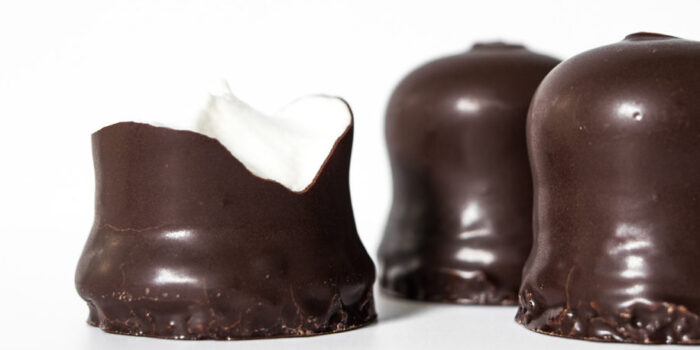
Indispensable for a night of Netflix, perfect for a food fight: the familiar, erm… zoen. Because negerzoen, of course, really isn’t acceptable anymore. Where do they come from? And how are they actually made?

Where do negerzoenen come from?
They have existed for two hundred years and are a Danish delicacy. They are called flødebolle there, a slur for a snob. Not much later, they also appeared on the Dutch market as negerzoen. They were made in the pastry bakery of the Buijs family in Oudenbosch. The famous bright-yellow boxes with blue lettering – now bearing the name Buys, for international reasons – are still filled with zoenen according to Bernardus Buijs’s old recipe.
Are they still called negerzoen?
No, fortunately that name was changed to ‘zoen’ in 2005, after mountains of protest. In France it was even worse: there, those chocolate treats were called ‘tête de nègre’, or negro’s head, for years, while in Flemish they were even referred to as ‘negerinnentet’. The name was changed in other countries too: Negerküsse became Schokoküsse or Schaumküsse, negro kisses became angel kisses, and the Finnish neekerin Suukot became Brunberg suukot, named after producer Brunberg. In Canada, the zoenen are called ‘viva puffs’, and in 2010 a clever bartender turned one into a shot: a miniature glass containing marshmallow vodka, crème de cacao and (how do you think of it) raspberry liqueur.
How are they made?
You can make them yourself: biscuits with Italian meringue, dipped in melted chocolate. How does it work in the factory? There, machines pipe thick dollops of egg-white foam with sugar and hot glucose onto the wafers. The zoenen have to dry for a while and then travel along the conveyor belt through a chocolate waterfall. On peak days, as many as 440 zoenen roll off the belt every minute. They are all wrapped by hand, because they are so fragile that no machine can put them in the boxes without crushing them.
Read also:
- Six things you didn’t know about chocolate
- Leftover egg whites (or yolks)?
- 6 baffling products from Albert Heijn
Photo: Wouter de Bruijn (Flickr)


