


What is the difference between kebab, döner, gyros and shawarma?
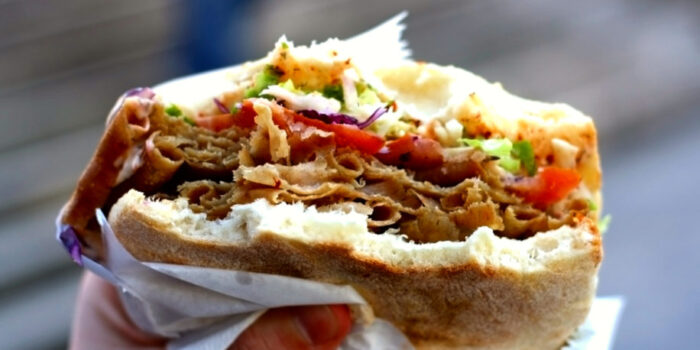
You often mindlessly wolf it down after your nocturnal escapades, when you’re a little the worse for wear (read: completely plastered) and stagger into the first snack bar you come across with a roaring hunger, but what exactly are the differences between döner, kebab, gyros and shawarma?

They are all iconic dishes that, when made well, deserve far more appreciation than they currently receive. But what exactly are the differences between these dishes? And how are you supposed to eat them? We’ll tell you.
Kebab
Kebab is grilled meat. Sometimes it is a piece of meat, sometimes it is minced meat pressed together, but in any case it is grilled, traditionally over coals or an open fire. You can also make kebab at home; we found this kebab grill for you, and it costs next to nothing.
Kebab is therefore not one specific type of dish. There are dozens, if not hundreds, of varieties in all kinds of shapes and sizes and with all kinds of spices. From Indian seekh and shami kebabs to Turkish şiş (also known as shashlik), Adana kebabs and Sergio Herman’s chicken kebab. Even Indonesian satay could essentially be called a type of kebab.
You may already see it coming: döner, gyros and shawarma are actually different types of kebab that closely resemble one another.
Döner
It all started with döner, which has been eaten in Turkey since the 17th century. It has also spawned many spin-offs, such as this Dutch döner sandwich with frikandel. It is therefore no surprise that Turkey approached the European Union to claim a protected status for döner. In Turkish, döner literally means ‘turning’, so döner kebab means ‘turning grilled meat.’
At first, it was prepared horizontally. That version is still available today as ‘Cağ Kebab’. Reportedly, it was Iskender Efendi, a chef in the Turkish city of Bursa, who came up with the idea of placing döner vertically in 1867.
There are undoubtedly all kinds of variations, but generally speaking, döner is made from seasoned minced meat. Traditionally lamb, but veal, turkey and chicken have also been used for several decades. The pieces are skewered onto the vertical spit, which is roasted, and strips are then sliced off. Like this.
How do you eat döner?
Döner is often eaten in a sandwich (pide) or wrap (lavash) with some green lettuce, onion and tomato. No hot sauce, and certainly no garlic sauce like we use here. At most, a little yoghurt on the side. It is at least as delicious served with rice (pilav). And if you see it on the menu, try Iskender kebab too: döner in yoghurt and tomato sauce, topped with melted (sheep’s) butter. Named after that same Iskender of vertical döner fame. According to Snackspert, this is the best döner in Amsterdam and perhaps even in the whole of the Netherlands.
Gyros
As often happens with dishes, döner also made its way to the neighbours: via Thessaloniki, it quickly spread throughout Greece. And just as döner means ‘turning’ in Turkish, gyros means ‘turning’ (or ‘round’) in Greek.
Basically, it is very similar to döner: seasoned meat stacked on a spit. But in Greece, pork (the neck) and chicken (thigh or breast) are mainly used. And unlike döner, the meat is stacked and not minced or pressed.
How do you eat gyros?
You usually eat it in a grilled pita, preferably with a little olive oil on it, some tomato, onion and lettuce, tzatziki on top and—yes—fries. In northern Greece, they sometimes go all out with ketchup and mustard too.
Shawarma
Last but not least: shawarma. Or shoarma, whichever you prefer. This too can be traced back to the Turks. Shawarama is the Arabic pronunciation of the Turkish word çevirme, which—just like döner—means turning. The Turks pronounce ‘Ç’ as ‘tsj’, but that letter does not exist in Arabic, so it became ‘sh’.
Unlike döner, shawarma—like gyros—is not made from minced meat but from pieces of meat. It is otherwise stacked on the spit in the same way. Chicken and lamb are most common, but beef is also used. In the Netherlands, it is often pork as well.
How do you eat shawarma?
In the Netherlands, it is actually eaten in exactly the same way as döner: in a sandwich, in a wrap or as a platter. But in the Middle East, the toppings are indeed different. Tahini or amba dressings, fresh parsley, a little lemon, tomatoes, cucumber and pickled vegetables, all together in a flatbread such as laffa—then dig in.
Read also:
- An ode to shawarma
- Why ketchup on steak really is delicious
- Recipe: Sucuk pide (Turkish flatbread with sausage)


