


Why are there so many carrots on supermarket shelves?
A trip to the supermarket regularly makes us raise our eyebrows. If it’s not because of the ridiculously high prices, it’s because of the strange products we find in the selection. Or the selection itself. The gigantic quantities of grated cheese and chicken breast, for example. But the enormous quantity of carrots is also striking.

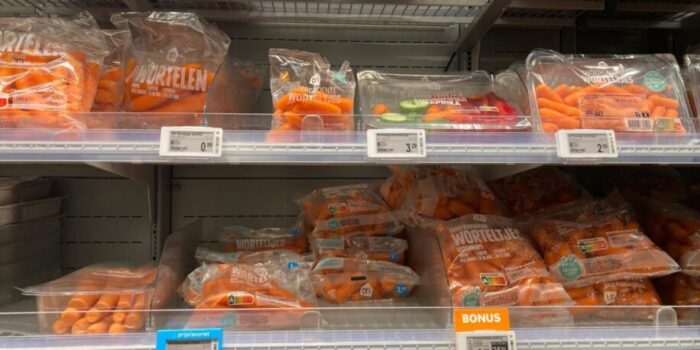
Carrots. Scraped carrots. Baby snack carrots. Bunched carrots. Peeled bunched carrots. Winter carrots, including the organic variety. Julienne carrots. Mini carrots. Rainbow carrot mix. The choice is huge, even though you simply want a carrot. Are all those carrots really that different from one another? Or what’s going on here?
Carrot vs. carrot
Okay, I understand that there are winter carrots and bunched carrots on the shelves. They differ in texture, and you also use them in different ways in your dishes. Bunched carrots are fresh and sweet: you can easily eat them raw or add them to your salad. Winter carrots are sweet too, but firmer in texture than bunched carrots. These are better stewed, baked or added to soup. There, at least your choice-induced stress between bunched and winter carrots is solved.
To make things a little more complicated: what’s the difference between *peen* and *wortel*? Or are they basically the same thing? Not quite. *Wortel* always refers to the part that grows underground. *Peen* can refer to the entire plant, meaning the root with its green foliage, but it can also indicate a type of vegetable. Winter carrots and bunched carrots, in other words. There are also washed carrots. These are bunched carrots, but—as the name suggests—washed and without the foliage.
Mini carrots a.k.a. baby snack carrots
The confusion mainly lies in the other varieties. The carrots, that is, without the foliage. You also have a scraped version, a snack-vegetable version and a mini version. I assume the last two are simply the same thing. But did you know that those mini carrots or baby snack carrots are often simply smaller versions of large carrots? The idea behind them was that mini carrots were originally created to save larger, misshapen carrots. By cutting the good parts of misshapen carrots into small pieces and scraping them, they could still be eaten. But they also generate a lot of profit.
Proportionally, you pay quite a bit more for baby snack carrots/mini carrots compared with ‘regular’ carrots. At Albert Heijn, you pay €1.09 for a 500-gram bag of carrots. A 150-gram bag of baby snack carrots costs €0.99. A huge price difference. At Jumbo, a kilo of carrots costs €1.69, while a 150-gram bag of mini carrots costs €0.89. The carrots seem to taste the same to me. Baby snack/mini carrots are just a little easier to eat. Albert Heijn, for example, says that its baby snack carrots are ‘cut into convenient sticks’. Jumbo calls them ‘scraped carrots’.
What a waste!
So you have small carrots that have been scraped and larger carrots that have been scraped. Small or large, both varieties are more expensive than unscraped carrots. The scraping is done for one reason: we want convenience. Apparently, none of us feels like scraping, cutting, peeling and shaving them ourselves. We want carrots we can eat out of hand, or at least don’t want to make any effort to get them ‘perfect’ ourselves. And so perfectly good but misshapen vegetables are thrown away (what a waste!) and we all pay too much for the same thing (what a waste!).
Also read:


