



You’ve Been Eating Your Banana Wrong Your Entire Life
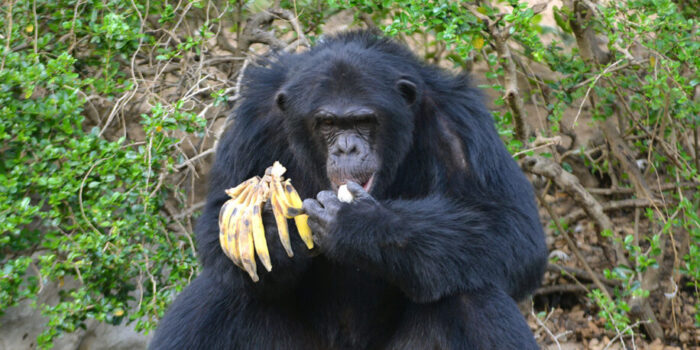
Genetically speaking, humans are 60 percent identical to bananas* and 99 percent identical to chimpanzees. In a roundabout way, it therefore makes sense to learn the right way to peel a banana from chimpanzees. And guess what: you’ve been doing it wrong your entire life.

Do you also always grab the banana by the stem and try to snap it? The result: brown spots, banana pulp sometimes squirting out along the stem, and sometimes you can’t open it at all. A shame, because bananas are incredibly healthy; they contain potassium, magnesium and fiber, for example. The experts’ tip: eat a banana every day, especially if you’re going to exercise. And a brown, bruised banana isn’t really a problem if you’re going to make a smoothie with it anyway, but if you want to bite into it like this it does look slightly less appealing.
The stem is sturdy
What’s wrong with the stem? It’s actually the sturdiest part of the banana. Not surprising when you consider how it grows: from that stem, more or less straight up into the air. So yes, a stem like that has to be able to hold its own. If you always thought the stem was the top of the banana, you were mistaken: the stem that holds the bunch together is actually the bottom.
Monkey knows best
Look at our genetic relatives, the chimpanzees. They know exactly how to peel a banana as quickly as possible. Because here’s the trick: start at the top. The opposite end from the stem, that is. Squeeze it there and the banana opens easily. An added bonus: your first bite won’t contain that little black blob that’s always found by the stem. It isn’t a spider leg, as is claimed on the internet, but the remnant of the flower from which the banana grew.
Use your teeth
Although it is often said that chimpanzees eat their bananas this way, it turns out to be a myth. “In the wild, apes don’t actually eat bananas,” says primate expert Katherine Milton. “And if they are given one, for example at the zoo, they simply sink their teeth into it.”
Read also:
- What do you do with the most expensive banana in the world? That’s right: eat it
- Shit, we really do have a serious banana problem
- 8 pieces of evidence that men handle their food very strangely
*) Oh, and are you wondering: how am I genetically related to a banana? That delightful fact comes from Rutger Bregman’s book ‘Humankind: A Hopeful History’.


