


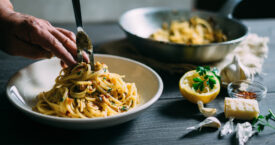
15 tips & tricks from culinary school that you can use right away
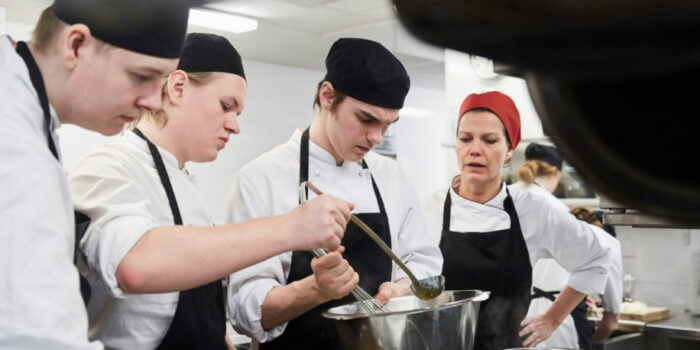
The road to the top as a chef can be long and tough, and we should count ourselves lucky that, relatively speaking, the Netherlands has so many chefs who belong to the absolute world elite. Would a brutally tough education followed by years of hard work to serve your guests one fantastic dish after another be something for you?

Now, suppose your answer to that question is ‘no’, but you are looking for some insider tricks that you can easily apply in your own kitchen – here are fifteen super-handy tips that can make everything run much more smoothly in your home kitchen too:
Sharpen your knives
Literally. It’s much safer to work with a sharp knife than a blunt one. Just think of it this way: if a knife can’t cut through something, where will it go? Sideways. What’s there? Your hand.
Make room for yourself
No matter how small your kitchen is, make sure you (temporarily) remove everything from the counter that you aren’t going to use so you have a clear work surface. That rum bottle, and those paracetamol strips? Get rid of them.
Ready, set…
Mise en place (putting everything in its place beforehand) is the reason professional kitchens can keep working so consistently. At home too, it’s useful to have your ingredients ready and weighed out before you put a pan on the stove.
Pat it dry
Always pat fish or meat dry with a paper towel before frying it. You want to get as little moisture as possible into the pan, because steam disrupts the entire process of browning and crisping. A wet coating will also stick to the pan more quickly, and you definitely want to avoid that.
Keep it thin
Peeling potatoes or carrots doesn’t have to take long if you use the right peeler. Chefs love Kuhn Rikon peelers. Buy them economically, especially if you’re the kind of person who occasionally throws one, unnoticed, into the trash along with the peels, never to see it again.
Chop chop
The size of the pieces you cut your vegetables into can make a difference to the end result. Those small, elegant cubes you see on restaurant plates cook more quickly and can therefore add textural variation to a dish. It’s fun (and looks professional) when every bite ‘brings’ something different.
Multifunctional
Perhaps you’re already a hobby pastry chef too, and have one of those incredibly handy dough scrapers at home. They cost next to nothing, and do you know what else they’re perfect for? Sweeping your cutting board or countertop clean between peeling and chopping tasks. That way, you don’t use your knife, which makes it blunt, and put your fingers at risk again.
Higher isn’t always better
Many ingredients come into their own when cooked over low heat. Onions taste best when they slowly sweat out their own sugars and cook in them, while garlic burns quickly, making it bitter and meaning you may as well start over. Soups and stews are best simmered slowly over low heat so all the flavors can come together and any meat in them doesn’t become tough.
Give your pan some space
To achieve the Maillard effect and allow food to brown and caramelize, your pan shouldn’t be too crowded. If, for example, you cram a lot of mushrooms or lots of chicken thighs into a hot pan, the moisture can’t escape and everything will steam-cook instead of frying to a delicious brown.
Stop talking and start cleaning (while you cook)
A golden tip you’ve probably heard before: keep the kitchen clean while you cook. As soon as you’re done with a spoon, pan or cutting board, put it in the dishwasher, wash it up and put it away. It saves you so much hassle once you’ve finished eating.
Fat chance? More like fat delicious
Butterbutterbutterbutter; if there’s one thing you learn to use a lot of at French culinary school, it’s that. Butter is delicious! But it also burns at higher temperatures, and that’s where oil comes in handy. Not every oil, but peanut oil or sunflower oil works well for high-heat frying or deep-frying. An oil with lots of flavor, such as a good olive oil, is less suitable for high temperatures; use it at room temperature or warmed only slightly in dressings, or drizzle it over your dish at the end.
Give your fish a butter bath
This is a top trick for restaurant-worthy fried fish: when it’s almost cooked, add a knob of butter to the pan and let it melt. Then gently spoon the melted butter over the fish so the top cooks without drying out, and the fish effectively gets its own aromas spooned back over it, along with the bonus flavor of butter.
Leftovers are your friend
If you plan to make your own stock (because you’re getting so wonderfully cheffy), it’s very useful to save all your chicken bones and trimmed vegetable scraps for it. Leek ends, carrot ends, onion ends—it can all go in. If you keep a resealable bag in the freezer, simply add the scraps to it until you have enough to get started.
Does it taste meh?
‘Well-seasoned’ is a term professionals throw around as casually as salt. Because that’s what it means, and that’s what it involves. Salt is used generously, mainly to make almost every type of food taste more ‘like itself’. Have you used enough salt when making a cauliflower dish? Then it will probably taste deliciously like: cauliflower. Used too little salt? Suddenly it no longer tastes like cauliflower, but like ‘nothing’. With every ingredient you add (at every step), you should add a tiny bit of salt until the whole dish is properly seasoned.
Too salty? Reach for acid
You’re diligently salting, then suddenly go too far and it’s too salty. Try balancing it with acid, such as a squeeze of lemon juice or a small splash of vinegar. Acidity brings many dishes into balance anyway—try it with a few drops of lemon juice over your roasted chicken, or in, for example, broccoli soup.
Read also:
- Join us in the oven – culinary school in seven lessons
- Coming soon to TV: new documentary series with Dutch star chefs
- From dishwasher to star chef: here’s how


