


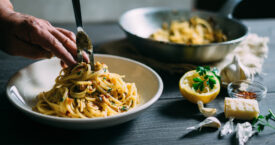
Crazy: shrinkflation is also rife in the hospitality industry

You probably already knew that we’re being ripped off in the supermarket with shrinkflation. The Consumers’ Association is so fed up with it that they’re taking the matter to court soon. But did you also know that the shrinkflation ‘trick’ is widely used in the hospitality industry? Smaller portions for the same price or even a higher price—you see it in quite a few restaurants.

Higher energy prices, staff costs and purchasing costs meant that business owners had no choice but to raise their prices. That’s called inflation. Almost 72% of business owners made their menu prices more expensive without adjusting their portion sizes. This is according to a survey by Misset Horeca, in which 1,200 hospitality business owners from across the country took part. But the same survey also shows that business owners are engaging in shrinkflation.
6% of business owners did not raise their prices, but did reduce their portions. Shocking: no less than 18.8% of business owners both raised their prices and reduced their portions. Gulp.
Lower profit margin
According to business owners, the reason for engaging in shrinkflation is simple. They want to preserve their gross profit margins as much as possible. With those higher energy, staffing and purchasing costs, that is almost impossible if they don’t raise their own prices. Still, it isn’t possible to pass on the price increases one-to-one. The dishes on the menu would then become so expensive that guests would stay away. Conclusion: many business owners have to accept a lower profit margin.
Shrinkflation: fewer garnishes
What does shrinkflation look like on your plate? You’re most likely to notice something in the amount of garnishes on your plate. You’ll probably get fewer fries or less salad with your order. Some business owners also buy their garnishes more cheaply. That may mean a lower quality of fries or salad in your portion. But, as they themselves say: the main course itself—your steak or salmon, for example—can therefore remain good quality.
Shrinkflation: cheaper products
It may also be that you see fewer spectacular high end products on the menu. Tournedos, for example, have a very high purchasing cost; some business owners choose to replace them with a more affordable cut of meat. Do such products remain on the menu? Then there’s a good chance you’ll get a smaller piece of meat. If your steak used to weigh 220 grams, you’ll probably now get a portion of between 180 and 200 grams.
(In)understanding
Misset Horeca also surveyed guests’ reactions to this shrinkflation trend. And what does it show? There isn’t all that much complaining about this phenomenon. In fact, guests actually show quite a bit of understanding. Misset Horeca, for example, spoke to the owner of a hotel restaurant in a village (name unknown), who said: ‘Sometimes they (guests) even say: it was about time prices went up.’ Still, not every guest agrees. 15% call shrinkflation ‘deception of guests’ that ‘doesn’t fit with what the hospitality industry should be’.
Solutions
The survey participants also suggested solutions—or alternatives—to shrinkflation. We recently saw one of them at The Harbour Club: introduce a dynamic pricing strategy. At The Harbour Club, they offer their dishes at a lower price during quiet periods. But of course, the reverse is also possible: make your dishes a little more expensive when it’s busier. Or offer different portion sizes at different prices. Larger portions would then cost more than smaller portions.
Whatever the eventual solution turns out to be, we do hope that shrinkflation comes to an end soon. Even though we understand that business owners are having a pretty hard time with inflation too.
Also read:
- 10x these are the most striking examples of shrinkflation—from garlic sauce to crisps
- Greedflation is a thing, and we’re not happy about it
- Help: are hospitality prices going to rise even further?
Source: Misset Horeca


