


Japanese vs. American mayo: what are the differences?
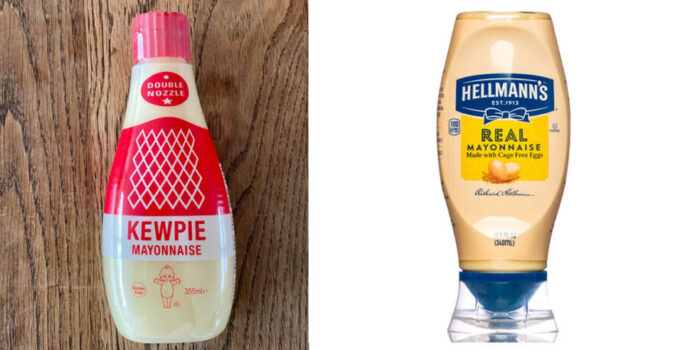
There’s usually plenty of choice when you’re standing in front of the mayonnaise shelf at the supermarket. Hellmann’s (Real) Mayonnaise, with its distinctive blue-and-yellow label, has also become well established by now. The Japanese Kewpie Mayonnaise is a little less widely available, but we hope to change that (as you may have gathered). And what exactly are the differences between the two?

Because the observant viewer will already have noticed that both are spelled with a double n, which gives them the sauce of all sauces in English. But if you like to be a little worldly-wise in the mayo landscape, you may want to know what distinguishes this one international mayonnaise from the other…
Hellmann’s: a well-traveled type
First of all, the Hellmann’s story in the Netherlands is rather confusing anyway. Hellmann’s is originally American mayo, and was (most likely) based on the German family recipe of Mrs. Hellmann at the beginning of the twentieth century. But the typical texture of American Hellmann’s did not go down so well with the Dutch test panel when Unilever introduced the brand here in 2014. The American original is light and even slightly jelly-like in texture.
Apparently, the Dutch tasters liked that less than what they were used to, so the recipe was adapted to make it resemble Calvé-style mayo more in the Netherlands. A shame, if you ask us! Isn’t it precisely fun to have variety and let different types exist alongside each other? Not everything in your kitchen cupboard has to look alike… But anyway, the recipe subsequently used in the factory was an English recipe. So we’re talking about American mayonnaise for the Dutch, initially based on a German recipe but now based on an English one after all. Okay…
Big in Japan
And Kewpie? We’ve written about it before; it’s Japanese mayo for which the Japanese inventor found his inspiration in 1920s America. You can read more about the history of Kewpie mayonnaise here. The biggest differences between the two are that Kewpie uses rice vinegar instead of ‘regular’ vinegar, which immediately gives it a distinctly Asian flavor. In addition, no whole eggs are used as in Hellmann’s, only egg yolks. Japanese mayo also contains no water, whereas American mayo does. Taken together, this results in a thicker mayonnaise with a slightly sweet flavor.
Using Japanese or American mayo
And are there differences in how they’re used? There are; just look at these special combinations with Japanese mayonnaise. In general, Americans typically eat their mayo on sandwiches, in tuna salad, or in the tastiest chicken salad. Japanese mayo, however, is eaten with many more kinds of dishes, including sweet ones (fruit salad! As an ice cream flavor!), or with pasta dishes, toast, noodles, or pancakes (including okonomiyaki; savory pancakes). They’re huge fans of it and encourage using it in anything you can think of that would taste good. Fun, right? And so you never run out, Japan even has a handbag-sized bottle of Kewpie, very appropriately called My Mayo. We’ll take it!
Read also:
- An ode to Zaanse mayonnaise
- How to: get more out of your jar of mayo
- This is the lemon mayonnaise of your dreams
Sources: Pogogi, Foodlog


