



Keuringsdienst van Waarde: this is how you get ripped off with nuts at the supermarket
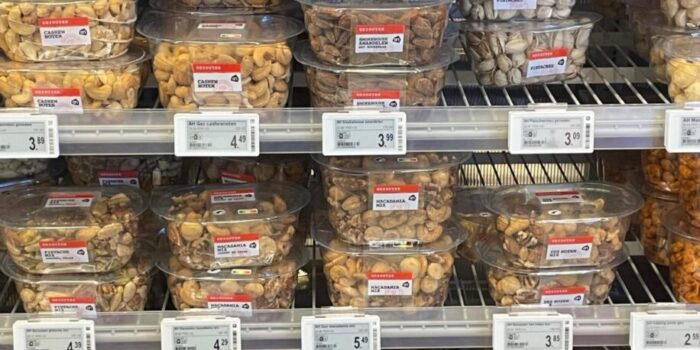
Have you ever seen what a jungle the nut aisle at the supermarket is? There are bags of nuts, tubs of nuts and, a few aisles further on—in the baking section—even more tubs of nuts. A nut is a nut, you might say. Until you look at the gigantic price differences. Why is a tub of nuts so much more expensive than a bag? Are we being taken for a ride by the supermarket? This was investigated on our favorite consumer program Keuringsdienst van Waarde.

The figures don’t lie. Anyone who researches walnuts in the supermarket quickly gets an error. A bag costs €14 per kilo, a plastic tub €24 per kilo, and a ‘more luxurious’ plastic tub (the kind you find in the baking section) no less than €44 per kilo. Hazelnuts in a tub are twice as expensive as hazelnuts in a bag: €28 per kilo compared with €14 per kilo. You’d almost think you were robbing your own wallet by choosing the tub. Or is there actually a reason for that enormous difference?
From Chile to China
Nuts are grown all over the world. Chile, France, China and North America, for example, are major nut-producing regions. In the episode of Keuringsdienst van Waarde, we hear that there can indeed be differences in the taste and quality of nuts, depending on where they come from. Both nut seller Dennis Bastiani and nut trader Dietrik Huizing, for example, describe nuts from China as astringent and bitter. They both prefer Chilean nuts: sweeter and fresher. Chinese nuts are cheap, but their quality needs to be monitored. French nuts, on the other hand, are extremely expensive, ‘just as most French things may be too expensive,’ according to Huizing.
Why more expensive?
Turn a package of nuts around sometime. Can you find the country of origin? The chances of success are slim. So you can’t find out whether your bag of supermarket nuts comes from France, China or Chile. Huizing finds it very difficult to determine exactly where the price differences between nuts come from. Maybe it’s the transporter, the packaging, any seasoning added to the nuts, or the possible coating around them?
Roasted—or rather, deep-fried nuts
Speaking of processing nuts: during the episode, we discover that ‘roasting nuts’ is actually the same as ‘deep-frying nuts’. Nut producer Jan Gotjé shows how a large batch of nuts is lowered into a huge vat of oil. So they don’t go into the oven, as you and I might have thought from the word ‘roasted’. Why, then, does the packaging say ‘roasted nuts’? ‘Probably because “roasting” sounds nicer,’ Gotjé explains. Well, fair enough.
Mix it up
Gotjé is particularly amazed by how incredibly expensive nut mixes are. A bag of macadamia mix costs €20 per kilo. If you take all the nuts out of the bag separately and mix them yourself, you’ll pay much less. According to presenter Marijn Frank, a bag of nut mix can cost as much as 80% more (!) than mixing individual bags of nuts yourself. Bizarre, right?!
A nut is a nut
One thing is certain: nuts from the same supermarket taste the same. Whether they come in a bag, a tub or a ‘luxury’ tub. Nut farmer Roderik de Vries, who grows his nuts on Dutch trees, can’t taste any difference between the walnuts either. ‘They’re simply walnuts.’ He considers it highly likely that those walnuts all ‘come from the same boat, and perhaps even from the same tree’.
We’re crazy
And then, at the end of the episode, the truth finally comes out. Presenter Ersin Kiris calls a nut trader who supplies supermarkets. He comes out with a very striking statement: ‘If they look more luxurious, people are willing to pay more for them. And we charge whatever the fool is willing to pay.’ In short, you’re paying for a plastic tub. While nut producer Gotjé says that such a tub actually costs only ‘two dimes more’.
Are there really that many fools, Kiris wonders? ‘There are millions of us walking around, so yes,’ says the nut trader. So don’t be a fool anymore. From now on, you know better. And here’s a message for the supermarket: we’ve caught you (again)!
Read also:
- Keuringsdienst van Waarde investigates: why are raisins so much cheaper than grapes?
- Disgusting: did you know this can be found in your cashews?
- Roasting nuts in the microwave: super easy
Source: Keuringsdienst van Waarde/KRO-NCRV


