


Seven things you shouldn’t do when you’re in Japan but probably will

Not so long ago, Japan as a travel destination was reserved for true connoisseurs. Those days are over: everyone and their mother has Japan in their sights, and the country is being swamped by a tsunami of mass tourism. Here and there, of course, that creates a serious culture clash between the refined Japanese and the boorish Westerners. So keep the following tips in mind to avoid making too much of a fool of yourself in Japan, the land of serenity. In short, things you’re going to do but can quite easily leave out.

Tourist in Japan? Don’t do this
1. Talking loudly on the metro
You’re in a country where politeness isn’t an obligation, but simply a way of life. So turn down that internal volume knob when you get on the metro. Of course, you’re allowed to talk quietly, but be aware of your surroundings. In fact, take a chill pill altogether when you travel to the land of the rising sun. On the street, in restaurants, the park or the temple, the motto is: keep it down.
2. Giving a tip
Let’s be honest, you, as a stingy Dutch person, obviously don’t give a tip if you don’t absolutely have to. In many (Asian) countries, it’s not particularly customary to tip, but it’s still appreciated and you can absolutely feel free to do so. A small extra as a token of appreciation is always a lovely gesture. In Japan, however, they don’t see you getting rid of your loose change as a respectful gesture. Still want to do something for that friendly tour guide or helpful hotel receptionist? Put some bills in an envelope and hand it over personally. It will undoubtedly be greatly appreciated. Arigato gozaimasu!
3. Pouring your own drink
I admit it: as a hedonist through and through, I sometimes struggle with this one myself. Because yes, you’re having a great time – that sashimi needs to swim, preferably in an aquarium of sake. But drinking sake is a team sport. The etiquette surrounding this traditional rice wine is quite complicated. The most important rule: pour for your drinking companion first, and then they do the same for you. If you pour your own drink anyway, the Japanese call it tejaku. Anyone guilty of this is promptly thrown out of the country…
Okay, that last part is nonsense, but they really don’t think it’s cool. Other rules include:
- hold your ceramic ochoco (sake cup) with both hands when drinking
- don’t knock it back in one go; it’s not a tequila shot
- leave a little behind so you don’t pressure anyone into drinking faster
4. Breaking chopstick etiquette
Did you know that every time a tourist sticks a chopstick INTO a piece of sushi, a sweet little granny dies somewhere in Japan? No? So stop it! You don’t have to be a pro, but practice a little with chopsticks before you go on vacation (the lower down you hold them, the more hopeless you look). Golden rule: use them only to transport food from your plate to your mouth. So don’t use them to point at someone; that’s called sashi hashi. Don’t touch food you’re not going to eat. And don’t pass food to one another with your chopsticks. Once you’ve finished your ramen, don’t place the chopsticks on your soup bowl; put them beside it on the chopstick rest.
5. Messing around with your sushi
There are quite a few rules attached to eating sushi too. This isn’t free-form school, nor that all-you-can-eat place around the corner, so follow them. It often goes wrong with the soy sauce. We have a tendency to drown the maki in it, but that’s not the point. And pay particular attention to the rice: you’re NOT supposed to dip it in the soy sauce. Also, stop mixing the soy sauce and wasabi until it turns into a poop-brown mush. Speaking of wasabi: the itamae (sushi chef) decides whether and how much wasabi goes on your nigiri, so you really don’t need to do that yourself. The chef is in charge anyway, especially if you sit at the counter. So you don’t need to customize your sushi yourself. Trust their expertise! There are hundreds of other rules, but we’ll end with this one: eat every piece of sushi in one go. No hamster bites as if you’re a twelve-year-old, just slide it straight in.
6. Harassing geishas
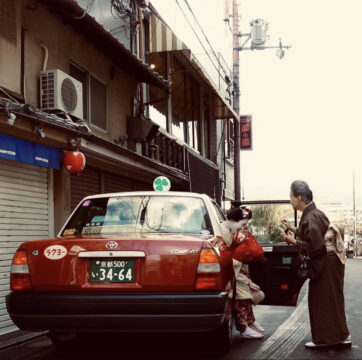
Ever since you watched Memoirs of a Geisha as a teenager, you’ve dreamed of spotting a real geisha in the wild. So you head to Gion in Kyoto, the geisha district par excellence. And every now and then you do indeed see a geisha here (or a maiko, a geisha in training). Very special. Unfortunately, Gion’s serene calm has been seriously disrupted since mass tourism arrived in Japan. Tourists often don’t keep their distance, chase geishas in the hope of getting a photo for Insta, and sometimes even shout at them. Shameful behavior. Don’t do this. Incidentally, downtown Kyoto is teeming with fake geishas. They’re simply local Japanese tourists who spend a day strolling through the park in kimono. A real geisha is a rare phenomenon.
7. Visiting only the major cities
The Japanese cities most popular with travelers are Tokyo, Osaka and Kyoto. Naturally, the mythical Mount Fuji is also a major attraction. By all means explore these places; they’re all worth it. But make use of Japan’s fantastic rail network and check out the lesser-known cities and regions too. Kyushu, the southernmost island, offers beautiful nature and fascinating cities such as Nagasaki and Fukuoka, Japan’s street-food capital. Hiroshima is a beautiful city with an interesting history and the best okonomiyaki you’ll ever eat. Head to Kobe for wagyu. Visit the onsens (natural hot springs) in the Japanese Alps or travel even farther north to discover untouched Japan in Hokkaido. Completely off the beaten path is Okinawa, Japan’s only tropical island, two thousand kilometers away. In short, there’s so much to discover in Japan. And wherever you are, you can eat an amazing bowl of ramen everywhere.
Read also:


