



Shrimp vs. prawns: what’s the difference?
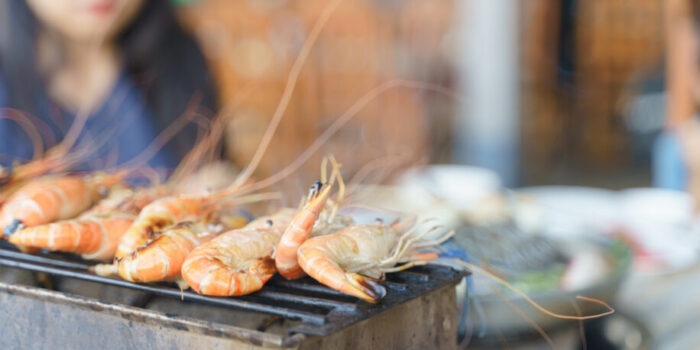
When you’re an avid reader of food sites (hey you) and, with your broad outlook, you also often find yourself browsing international sites in search of all kinds of delicious things, you may have found yourself confused about gamba’s, shrimp, shrimp and prawns. Not to mention scampi and langoustines! So: what’s the deal??

Because are shrimp and prawns interchangeable, and what the hell are scampi anyway? If they all end up deliciously in your stomach, for example via pad thai with shrimp, you’re probably perfectly happy already, but this knowledge may still come in handy…
All pink little creatures
But not when they’re still swimming in the sea. Our Dutch shrimp naturally remain beautifully grayish, and most of these other creatures only turn pink when heated. To explain it simply: in the Netherlands, we’re used to calling the smaller species (such as the Dutch and Icelandic varieties) shrimp, and the larger species prawns, or king prawns. They all come from tropical waters. So prawns are shrimp. This is still more or less in line with what English speakers call shrimp (small) and prawns (large).
Like a shrimp without a head
But are prawns the same as scampi? No. Officially, certainly not, but we ourselves have created the confusing habit of calling headless prawns scampi. No idea why, and it’s inconvenient too. Scampi is already plural; one specimen is called a scampo. And to explain the difference from a prawn as clearly as possible: a prawn belongs to the shrimp family, while a scampo belongs to the lobster family. In North America too, it has become more common to use the term scampi for all (dishes made from or with) large shrimp, especially when fried in olive oil with garlic.
Rival gangs
So are scampi and langoustines at least (for heaven’s sake) the same thing?? Yes! We can cross that one off. And a langoustine and a spiny lobster? No, those aren’t the same either. Still following? Because a langoustine (scampo) has claws, while a spiny lobster does not.
And as a final twist: the crayfish. A freshwater species, whose aggressive American cousin has long been known to have come in and seriously—and in great numbers—bullied our well-behaved European crayfish. So we stand by this as the best tactic for teaching it a lesson: eat it! In a salad with crayfish, for example. There’s a good chance that the crayfish you buy at the supermarket have been flown in from China rather than caught in the wild in Friesland, but that catch also appears to be fairly sustainable.
Read also:
- Kapsalon extravaganza-de-luxe (with lobster!)
- Large garlic shrimp with white wine
- Bizarre and disgusting behavior by hospitality guests #2


