


The French Pyrenees are a wonderful foodie destination (plus: to-do list)

No holiday plans yet? Then there’s nothing stopping you from heading down to the French Pyrenees, perhaps the loveliest last-minute foodie destination we can think of. Here’s a to-do list to get you started:

Eating tapas in Perpignan
Tapas—you eat those in Spain, right? Correct. But here too. This part of France is actually a kind of Northern Catalonia, and you can tell in everything. The language spoken here, the street signs, and the food are (partly) Catalan. Mussels, aioli, pan con tomate, patatas bravas, anchovies, jamón, as well as snails and foie gras, frequently end up on your plate here. So even if you can’t decide whether you prefer French or Spanish food, you’ll feel right at home here!
Oh, and you don’t necessarily have to go tapas-hopping in Perpignan, but if you’re planning to do so anyway, head to Txoko. It’s right next to the fourteenth-century monument Le Castillet in the center of the old town, so you’ll not only eat the tastiest tapas, but also soak up the atmosphere of the city. Who knows, perhaps the people on the terrace will spontaneously start dancing, just as they did when we were there.
Foraging on the garrigue
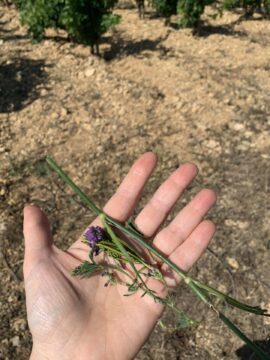
The garrigue: that endless, low-lying landscape where the scorching sun makes the air shimmer with everything that grows and blooms. Indeed, it’s enough to make you lyrical. Breathe in the scents of wild fennel, alfalfa (you may know its sprouted seeds as alfalfa), rosemary, thyme, wild asparagus, wild rocket and lavender, and pick those fragrant herbs yourself to finish your dishes. For example, when you want to make these savoury madeleines.
Now, your self-picked wild herbs are by definition organic, although a little fox may have peed on them, but this region is proud to be France’s number-one area for organic farming. Of course, it helps enormously that the weather conditions are so suitable, with plenty of wind (they distinguish eight different winds here, and they all have a name) and little rain.
Drinking vin doux naturel with cake and chocolate
That you’re going to drink wine in France is a no brainer, and because it’s sweet wine—vin doux naturel—that tops the charts here, it makes perfect sense to go for it. Take Banyuls, a fortified wine with two appellations of its own: AOC Banyuls and AOC Banyuls Grand Cru. The vineyards themselves are a spectacle, often situated on steep slopes overlooking the Mediterranean Sea. So don’t climb them in flip-flops. No, really, don’t.
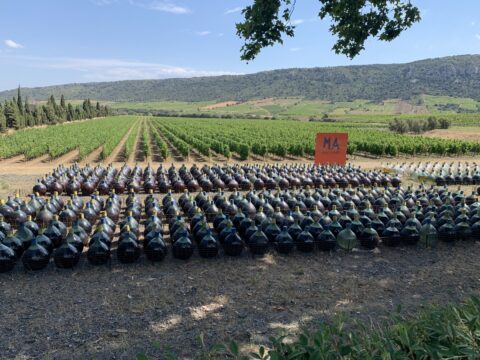
The wine comes in red, white and rosé, and, just like with port, alcohol is added during the fermentation process. Because this happens before all the sugars have fermented, the wine becomes wonderfully sweet. What’s special is that the wine is often also aged in large, bulbous glass bottles, which stand outside in the full sun.
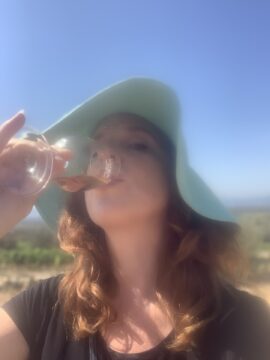
Muscat de Rivesaltes is another vin doux naturel from the Eastern Pyrenees, but this one is always white (or, more accurately, golden) and made from Muscat grapes. The combination with Roquefort is classic—and rightly so. The sweet, slightly syrupy yet also fresh character of the Rivesaltes with the cheese’s spicy, creamy notes is quite an experience. But here in the Pyrénées-Orientales, they are just as happy to eat it with pastries and ice cream, and that may be even more delicious. Or chocolate with the red Banyuls! Do yourself a favour and look for the best combination.
Learning everything about anchovies (and tasting them too!)
Anchovies are a classic in Spanish-French cuisine, and we’ve previously made a case for the little salty fish. In Collioure, a charming fishing village on the Mediterranean, they are happy to show you how they salt those little fish. But don’t be mistaken: although the sea creature is processed on the Mediterranean coast, it hardly swims there anymore. In fact, it is imported in shoals from, among other places, South America. At family business Maison Roque, which has been working with anchovies since 1870 and where five generations of saleurs have worked, we get to look around the atelier de fabrication.
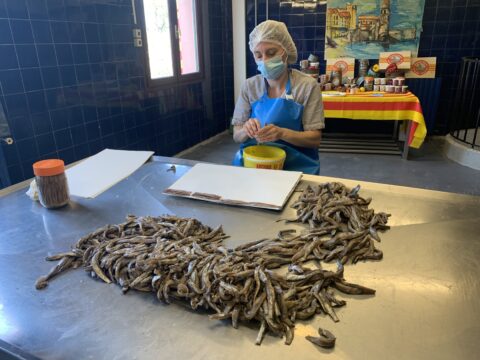
Here we see how the pre-salted fish are rapidly filleted by hand. After this, they are placed in plastic barrels again, once more with a generous layer of salt. A weight on the lid of the barrel provides the necessary pressure, allowing the salt to penetrate deep into the fish. After sometimes spending as long as a year in the barrel, the fish are processed further, for example into the beloved jars of anchovies in oil.
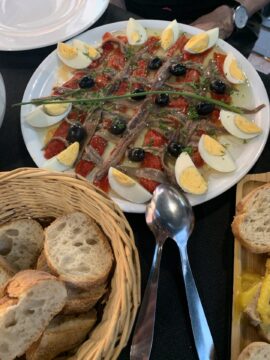
You can also go and see the women (those small, nimble hands!) at Anchois Roque, as well as the women next door at Maison Desclaux at work. They’ll also teach you a lot about the village’s anchovy history (in the past, practically the entire population was in the business), and of course you can taste and buy plenty. Oh, and they give away countless recipes with anchovies, but so do we… Chicken with anchovy butter—come on, seriously!
Visiting the olive-tree whisperer
Think raising children is a lot of hassle? Try starting an olive-tree plantation. Night feeds, piano lessons, school fees, exam stress—it’s nothing compared with the troubles a few olive trees can cause you. They need perfect care to become ‘their best selves’, require an enormous amount of space (can’t you already hear your teenager saying that?) and don’t bear their first fruit until after 15 years.
But just as you love your children unbelievably much despite everything, the olive-tree whisperer at Mas Boutet feels the same way about his trees. And it’s mutual—that’s what Gildas Girodeau, who also writes thrillers, is convinced of. His trees, a family affair consisting of very old as well as younger trees, communicate with him in a particular way. In any case, he can ‘read’ them perfectly well. But what he’s even better at is telling their story.
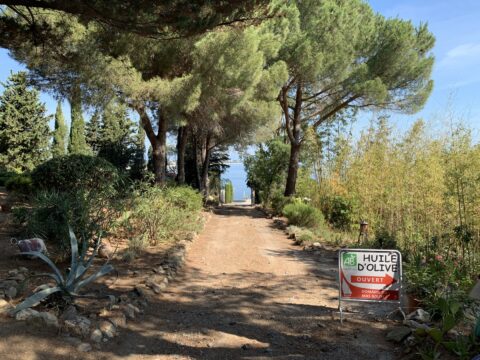
After a visit to Mas Boutet in Argelès-sur-Mer, you’ll know everything about olive oil and, duh, you’ll also have had the chance to taste the delicious organically certified products made by him and his wife Isabelle, which he sells to the best restaurants in the area—and to you, if you make the effort to travel to Argelès-sur-Mer. We can’t imagine why you wouldn’t.
Read also:
- These are the most important lessons I learned while working in professional kitchens
- Staff reveal: these are the craziest orders ever
- The bubble is about to burst: France’s champagne problem


