



This Is How Olives End Up in a Jar: Did You Know?

Anyone who has ever plucked an olive from a tree and enthusiastically popped it into their mouth knows: quite a bit still needs to happen before it tastes good. But what exactly? We’ll tell you!

As summer approaches, around June, the first baby olives appear on the trees. They start out bright green, but slowly turn olive green and, in some varieties, eventually become black. In September and October, it’s time to harvest. In some olive groves, pickers head out with ladders and buckets to pick the ripe olives. In other olive gardens, large sheets are first laid beneath the trees, after which the tree is ‘combed’ from the ground with a vibrating rake that makes the ripe olives fall from the branches. Gather the corners of the sheet together and the harvest is done.
Salt, water and patience
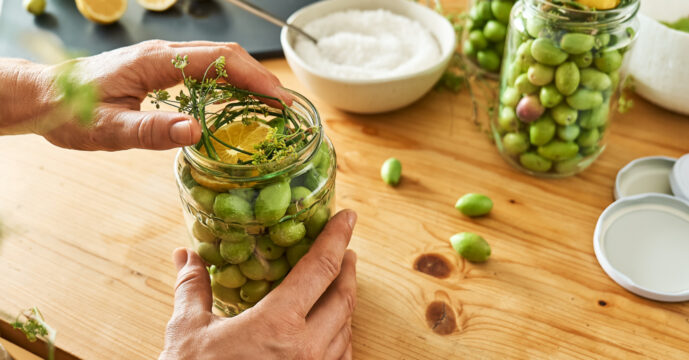
But you’re not there yet. Olives don’t taste good at all after harvesting; they still need some treatment. Salt, water and a whole lot of patience are all you need to turn those hard, bitter olives into something delicious. Some olives are first bruised or cut, while other varieties go into the brine bath untouched. Bitter olives spend only a few months in that brine, but those sticky, deliciously salty olives need a whole year. Only then can olives be given special flavors. They go into a jar with, for example, lemon peel, rosemary or red chili pepper. Or simply plain, because they’re delicious enough as they are.
Through the car wash
And olive oil? It takes around five kilos of olives to make a liter of oil. First, the olives go through the car wash, where any twigs and leaves are removed as well. Then they go through a press, just like grapes do when making wine. What comes out of the press is a coarse kind of tapenade, which also contains the grape pits. Traditionally, that mash is placed between mats: a layer of olive pulp, a mat, another layer of pulp, the next mat. Such a stack then goes into a press, where the oil is squeezed out of the mash.
These days, olive oil is also made in a centrifuge: the pulp spins around in a drum with tiny holes, so the oil is forced outward by centrifugal force. The first oil collected is extra virgin oil, the cold-pressed olive oil. As the press runs for longer, the olive pulp becomes warmer. The oil that trickles out of the press warm has less flavor and aroma than the cold oil. And the leftover olive mash, without oil? It is turned into animal feed or used as fertilizer in the olive grove. Zero waste!
Small or absolutely enormous
Every type of olive has its own character and flavor. The most famous Spanish olives are manzanilla olives: green, not very large and wonderfully juicy. Sometimes the pitted olive is stuffed with anchovy, a piece of red chili pepper or tuna. Kalamata olives belong in a Greek salad or on a drinks platter, alongside herby feta; they are those deep-purple Greek olives. Do you also know those small Taggiasca olives? Italian flavor bombs, often preserved with fresh herbs. And those huge green ones are Nocellara, olives from Sicily. They taste mild and deliciously fatty, just like olive oil. And also insanely delicious: Olive all’ascolana. According to FavorFlav’s Sharon, they’re even the most delicious olives in the world (although they do require a little effort).
With or without a pit?
Olives in a salad, in a sandwich or mixed into tapenade: yes, then you naturally choose pitted olives. But believe us: those with a pit are actually tastier. They’re often black olives, so ripe and soft that the olive farmer can’t easily remove the pit. Fine by us, because ripe olives are deliciously juicy. They’re preserved in salt—or in other delicious flavorings—and the pit itself also gives the olive a little extra flavor. So, if you ask us, olives served with drinks should always have a pit. Put a small bowl next to them so everyone can discreetly dispose of the pits, and put napkins on the table if things don’t go perfectly mess-free.
5x healthy olives
They don’t count toward your daily serving of vegetables or fruit, but olives are still super healthy. Why?
- They’re juicy little vitamin bombs: vitamins B1, B2, D and E. They also contain iron, which gives you energy.
- They’re good for your eyes. Yes, you read that right. The vitamin A in olives helps you see well in the dark.
- Olives and olive oil are packed with antioxidants, which slow down the aging process in your body.
- They have anti-inflammatory and pain-relieving properties.
- And they’re good for your heart: people who follow the Mediterranean diet live healthier and longer lives. Olives contain no cholesterol, but they do contain unsaturated, healthy fats.
Also read:


