



True pricing experiment: at Albert Heijn, you now pay extra for your coffee
Sometimes (read: often), I’m left reeling when I have to pay for a coffee – coffee has never been this expensive. At Albert Heijn, you’ll now also pay more for coffee – if you want to, that is. At several Albert Heijn branches, you can now pour yourself a cup of coffee for the so-called true price. What exactly does this mean, and is paying extra for coffee a thoughtful idea or a sneaky marketing ploy?

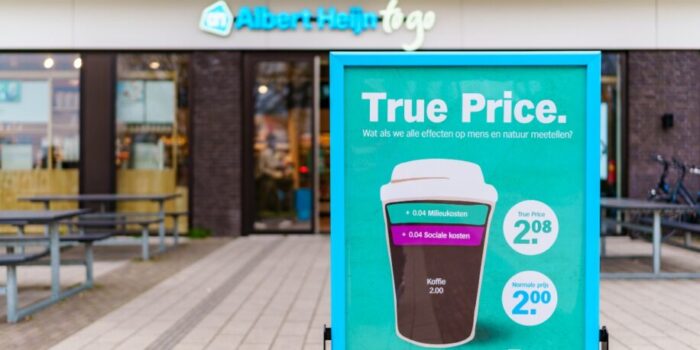
Customers at Albert Heijn to go stores in Groningen, Wageningen and Zaandam have recently been able to pour a cup of coffee for the true price; that’s the normal retail price plus the social and environmental costs throughout the product’s supply chain – coffee, in this case. Able to, yes, because the choice is yours. Do you pay two euros for your cappuccino at the checkout, or would you rather pay the true price of two euros and 28 cents?
True price, why?
The idea behind Albert Heijn’s true pricing experiment? The supermarket chain wants to raise awareness of social and environmental costs, help us make more sustainable choices and also learn what we think of it – according to Albert Heijn. Are we willing to pay extra? Are we good enough?
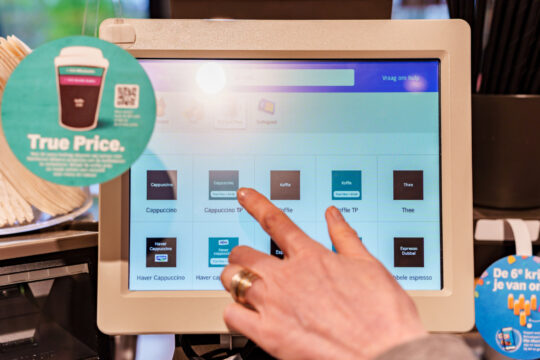
Customers in the three AH to go stores now see two prices when paying for a cup of coffee: the price they normally pay and the true price – the sum of various social and environmental costs, such as CO2 emissions, water consumption, use of raw materials and working conditions. The sum is based on the True Price method (a method for calculating the real price of products and services, designed by the Dutch company True Price).
Can’t Albert Heijn pay this itself?
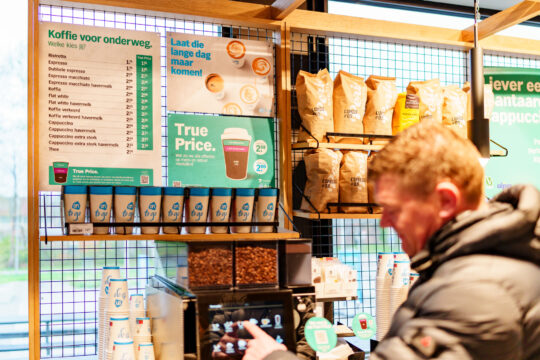
And if we pay extra, what happens to this additional income? When it comes to coffee, there is a clear proposition. All Perla coffee from Albert Heijn comes from Rainforest Alliance-certified coffee plantations. Albert Heijn says it will invest the proceeds from the extra amount we are willing to pay for true price coffee in Rainforest Alliance improvement projects in the coffee supply chain. After all, the normal retail price of a product does not cover the depletion inflicted on the environment and on coffee farmers in faraway countries. If we now pay extra money…
That’s where it doesn’t sit right with me. Albert Heijn often waves its sustainability initiatives around, but how honest are they? And why doesn’t Albert Heijn simply pay that true price itself? In inflationary 2022, parent company Ahold Delhaize even posted record profits. If Albert Heijn cares so much about its coffee farmers, couldn’t it simply pay them better? And isn’t responsibility for making the products on its shelves more sustainable also Albert Heijn’s own?
And, philosophizing further: where does this end? The chocolate industry is overflowing with misery; millions of cocoa farmers and their families live in poverty and face widespread child labor and deforestation. The shelves at Albert Heijn (and other supermarkets) are packed with products from Mars, Ferrero and Nestlé. Will there be true pricing for those too?
True pricing hypocritical?
Radar also wondered whether the true price is really fair. Environmental economist Paul Schenderling told Radar that he has his doubts. According to him, there is a great deal of hypocrisy in Dutch trade policy. In 2019, he calculated that a total of no fewer than 13.8 million people from faraway countries were working to serve Dutch consumption and exports. They often work in deplorable conditions. Will those extra 28 cents for a cappuccino make a difference in these people’s lives? In practice, the coffee farmer will barely notice it.
What do you think? Are you willing to pay extra for your coffee, or do you think that not the customer, but Albert Heijn itself should pay the costs of fair coffee?
Also read:
- Albert Heijn under fire over deposit fees
- Gross or gold? You can now buy Hawaiian pizza bitterballen at Albert Heijn
- 6x incomprehensible products from Albert Heijn
Source: Albert Heijn, Radar. Image: Albert Heijn


