


Why German food is hübsch and gemütlich
It’s remarkable that you can find a pizzeria in every village and a Chin. Ind. Rest. everywhere (but for how much longer?), while the traditional cuisine of our eastern neighbours is so poorly represented in the Netherlands. Unjustly so, because German food is wonderfully cosy and delicious – comfort food at its best. So I say: open a German restaurant immediately, and I’ll be sitting there every evening with a napkin around my neck.

Germany is so large that you may not even be able to speak of a typically German cuisine. There are East German traditions, centred mainly around pickles and sausage, Bavarian cuisine (I’m thinking: Oktoberfest!) and trendy Berlin, where they probably serve more litres of kale-chia-seed-oat-milk smoothies per capita than anywhere else in the world. It’s a shame that traditional German dishes are still not so bekannt in the Netherlands. Here are five reasons to change that.
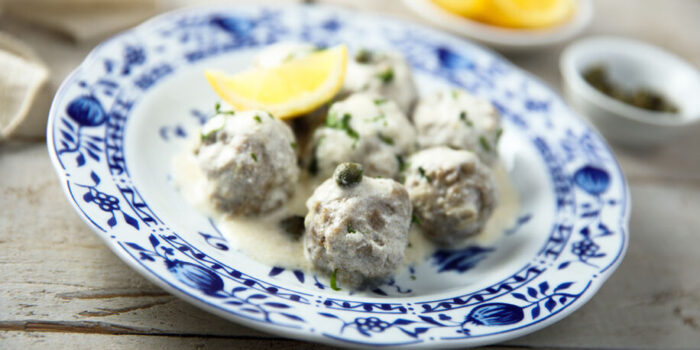
Königsberger Klopse
That sounds cosy: eating Klopse. They are meatballs in a cream sauce with capers. Delicious! The dish owes its royal name to Königsberg, the former capital of East Prussia. That is probably why these lovely meatballs – they get their flavour from anchovies, onion, egg, lemon and pepper – were called ‘kochklopse’ in East Germany. If you see them on a menu, you can’t make a wrong choice. Making Klopse yourself isn’t difficult either; with Google Translate or your secondary-school German, you can decipher such a recipe just fine.
Maultaschen
Small pouches of filled dough that you put in your mouth, sounds familiar? Yes, of course, that’s ravioli. But Maultaschen are ravioli à la German, filled with minced meat, breadcrumbs, onion and spinach. And then cooked in stock.
Zwiebelkuchen
A wonderfully fresh, warmly spicy little onion tart – that’s typically something for the wine regions. They serve a glass of Federweisse with it, by the way, if you’re there at the right time of year. Federweisse is young wine that still bubbles and tingles deliciously because it is fermenting. A perfect combination.
Pinkel with Grünkohl
Say Germany, and you say sausage. Everyone knows those Bratwursten and, of course, the Currywurst, which is so famous it has its own museum. But have you ever eaten Pinkel? They are small sausages (about as big as your little finger, yes), deliciously savoury, traditionally served with Grünkohl, which isn’t green cabbage, as we assumed, but kale. Make a mash with bacon and mustard, add a few of those cosy sausages, and all is right with the world.
Quarkbällchen
Those with a sweet tooth can hardly leave Germany anymore, because everywhere it’s cake, cake and more cake. Good to know: it’s rude to take just one slice of cake when you’re visiting someone; the host and hostess will wonder whether you have an illness or dislike them. Insider tip: Quarkbällchen, little quark balls. They are small doughnut holes made from batter with quark and baking powder. They’re fresh and airy, dusted with icing sugar, and you do indeed eat yourself completely sick on them.


