



Why Jamón Ibérico de Bellota Is the Best-Tasting Ham in the World
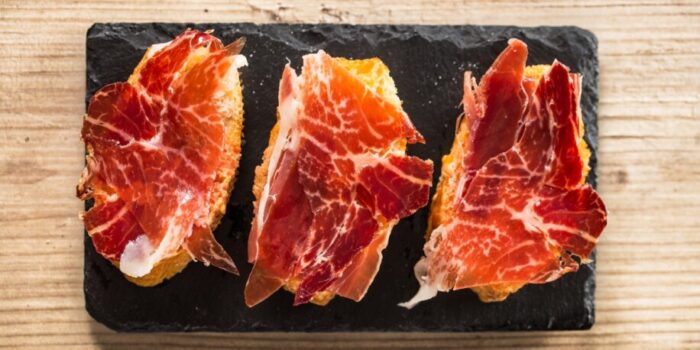
I’m a vegetarian, but really one of the hypocritical kind. The kind without any real principles, without a backbone. Because although I don’t eat meat, I make an exception for Wagyu (I know I’m coming across as disgustingly snobbish now – I prefer to call it: professional deformation) and Jamón Ibérico de Bellota. And this is why:

Best-known Spanish hams
When it comes to Spanish ham, people are usually talking about two types: Serrano ham and Ibérico ham. And although these two hams are often mentioned in the same breath, the differences between them are huge. The breed of pig, the diet the pig has followed and the processing of the ham all differ enormously. You can see this not only in the price (Iberian ham is more expensive), but also in the taste, texture and aroma of the two hams, which cannot be compared.
‘Jamón Serrano’ is made from white pigs. The pigs are fed grain and the ham is dried for about a year. Serrano ham smells sweet, has a warm, mild flavor and is leaner and saltier in taste than Ibérico ham.
Ibérico ham
‘Jamón Ibérico’ is made from black Iberian pigs, which are known as the best and most flavorful breed of pig in the world. They are fed grain. The ham has a fuller and richer flavor than Serrano ham. The ham is dried for at least a year, but depending on its size, the drying time can be extended.
Next-level Ibérico ham
But it can be even better, because there is a superior level of Ibérico ham: ‘Jamón Ibérico de Bellota’. This ham has an intense, complex flavor. The deliciously marbled meat is praised not only in Spain, but worldwide for its top quality. ‘Jamón Ibérico de Bellota is a ham with a fruity aroma and a slightly sweet, nutty and briny flavor. But it’s not only the taste; the story behind it is mouthwatering too…
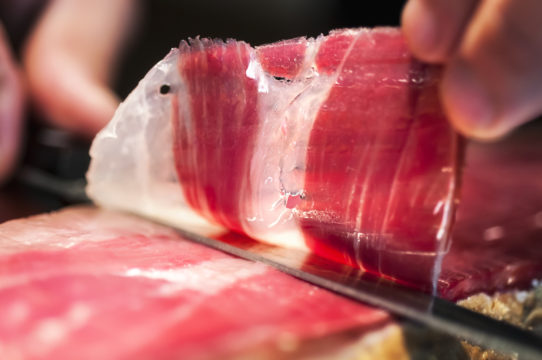
The grunting equivalent of Wagyu
Iberian pigs are descendants of the original Mediterranean wild boar. They are the grunting equivalent of Wagyu, the famous Japanese cattle breed. Ibérico pigs are found only on the Iberian Peninsula, and the breed is protected by Spanish laws and regulations. Not only is the name protected, but so is the entire chain from birth to slaughter, with the aim of keeping the breed as pure as possible and safeguarding the quality of life and the meat. Because of their distinctive black hoof, Ibérico pigs are also known as Pata Negra.
Special: the acorns
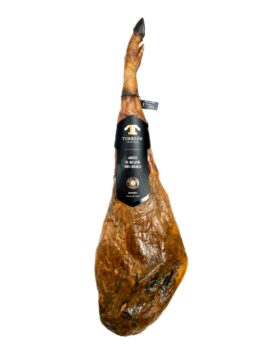
There are different qualities of Ibérico pig, ranging from cebo to bellota. Cebo pigs are the ‘standard’ Ibérico pigs, which can roam freely and eat a mixture of grains. They are cured for a shorter period than Bellota Ibérico pigs. Even more remarkable is the diet of Bellota Ibérico pigs. During the final 4–5 months of their growth, they eat nothing but acorns (bellotas), up to 10 kg a day! This period is called montanera (the acorns must be as ripe as possible) and takes place in acorn-rich forests between October and February. These acorns (and the aromatic wild plants they have enjoyed throughout their lives) give the ham its distinctive umami-rich flavor, aroma and ruby-red color. In addition, the fat they build up in their muscles creates a marbled pattern and a sweet flavor. It melts in your mouth!
The longer it cures, the more intense the flavor
The hams are not smoked, but simply rubbed with sea salt and then hung up for months to dry and cure before being brought to market. The forelegs (Paleta Ibérica Bellota, shoulder ham) are usually cured for 14–18 months, while the hind legs (Jamón Ibérico Bellota) are cured for 24 to 36 months. With ham, the same applies as with good wine or cheese: the longer the curing, the more intense the flavor (and often, the higher the price). Because of the difference in yield between the two hams, the foreleg is priced lower than the hind leg. Because it contains more fat, the paleta is slightly juicier.
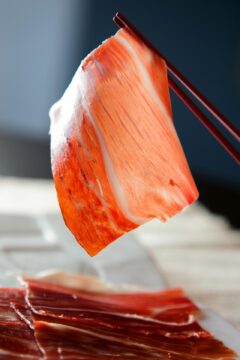
Best enjoyed at room temperature
Always let ham come to room temperature, because that’s when you taste its full flavor. The thinner the slices, the better the ham tastes. A delicious combination is ham on toasted baguette (tostada): first rub it with a fresh clove of garlic, then rub in tomato, drizzle with good olive oil and place the thin slices of ham on top. Also heavenly: a few drops of olive oil (or try some truly good truffle oil) on a slice of ham.
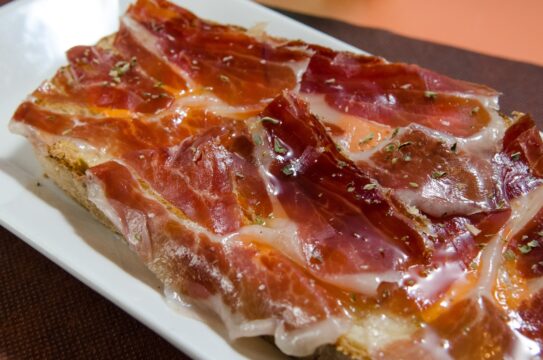
Cheers to your health!
Eating Jamón Ibérico de Bellota is healthy! It has a positive effect on your cholesterol level, and Bellota ham contains minerals such as magnesium, zinc and calcium, as well as vitamins including E, B1, B12 and folic acid. Spanish Bellota ham also fits very well into a low-calorie diet: a 50-gram serving contains just 150 kilocalories. Do the math!
From Verdejo to Sherry
Noblesse oblige; with such a delicious slice of ham, you naturally drink a lovely glass of Spanish wine. The soft and salty character pairs well with fresh white wines with a soft finish, such as a Verdejo. Prefer red? Pour a Rioja Crianza. With Ibérico ham, fortified Spanish Sherry, either Manzanilla or Fino, is an excellent choice. Manzanilla is drier, crisper and saltier than Fino. In northern Spain, Txakoli, the lightly sparkling, dry white wine with high acidity and low alcohol content, is popular with Ibérico ham.
Read also:
- How to become a charcuterie pro
- The difference between chouriço and chorizo
- All types of bacon in a row


