


What to eat for Chinese New Year for an extra portion of good luck
Happy Chinese New Year! Today is the day the Chinese astrological calendar celebrates its New Year (hooray, Year of the Rat), and for most Chinese people that comes with traditions such as cleaning the house, paying off debts, the famous dragon dances to the beat of loud drums, fireworks and lots of delicious, meaningful food.

The Chinese symbolism behind many types of food is exuberant anyway – imagine if in the Netherlands we said: ‘Those mashed potatoes in the hotchpotch symbolize wealth because of their soft golden glow, the carrots represent beautiful sunsets until the end of time, and the onion represents the tears every parent has shed for children who left home to go to university.’ Well, wouldn’t that be great! In China, they don’t shy away from it.
Count your blessings
Marjan Ippel: ‘During CNY (Chinese New Year), the whole family eats together. There is a lot of symbolism in what is eaten then – in numbers and in shape. At least nine different dishes must be on the table, because nine is a lucky number. Just like six and eight. And many snacks are round, symbolizing a well-rounded year, as well as togetherness in unity. Dishes are also eaten whose names sound similar to positive concepts such as success or long life.’ She asked several experts about their festive favorites, and we added even more symbolic dishes.
Here is a list of things eaten during Chinese New Year to bring good luck:
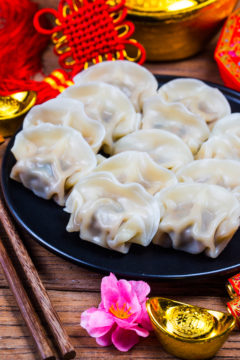
Jiaozi (dumplings)
According to sinologist Alice de Jong of Tokowijzer, there is only one thing you really have to eat during CNY and that is dumplings on ‘New Year’s Eve’. ‘You are together with your family and make jiaozi together.’ These dumplings, filled with ingredients such as minced meat and Chinese chives, resemble the golden yuan bao ingot. ‘Jiaozi’ also sounds like the very first paper money ever. Eating them promises prosperity in the new year. The family of Taiwanese Carine Lin I-Chun hides small coins in a few jiaozi. Whoever finds one with a coin inside can expect lots of good luck in the coming year.
Head-to-tail chicken, fish and duck
The Hong Kong-born tea merchant Amanda Yiu of Formocha Tea in Amsterdam explains that during CNY, chicken, fish or duck is served from head to tail. It symbolizes a complete year.
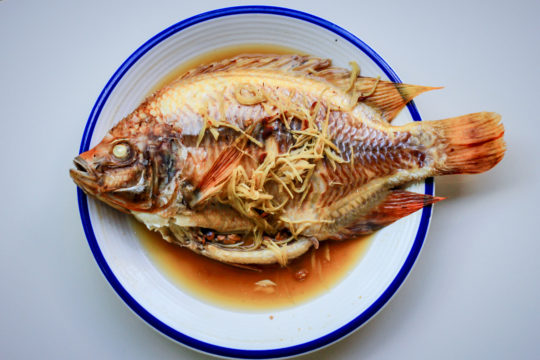
Steamed fish with ginger
Carine Lin I-Chun produces the traditional Taiwanese black soy sauce Wu Wan Wo (also available in the Netherlands). Together with her family, the Taiwanese woman eats whole steamed fish with ginger, for example. The fish symbolizes a year of abundance. To express that abundance, some is traditionally always left over for the next day. Vegetables, such as mustard greens, are also eaten whole. Boiled in water or chicken stock. This represents a long life.
Stir-fried prawns
Serving prawns expresses the wish that your life will be as energetic as a jumping prawn.
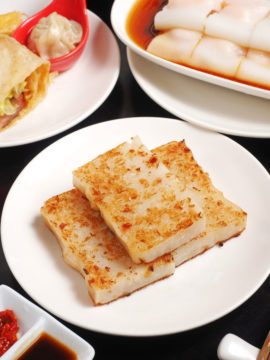
Chinese radish cake
The pronunciation of the typical winter vegetable daikon (Chinese radish), which is widely eaten during CNY, sounds like ‘good luck’ or ‘success’. Eating the cakes therefore symbolizes a good start to the new year, according to Carine Lin I-Chun.
Lots of sweets
According to tea expert Amanda Yiu, every region has its own customs, but sweets are eaten in abundance everywhere. Sweetness represents good luck. For example, sweet sesame balls make a sound while frying that resembles giggling. Once they come out of the fryer, they are partly split open and look as though they are smiling. And that promises a good start to the year.
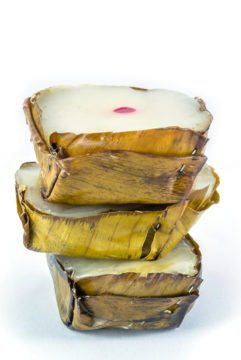
Nian Gao
Yiu’s favorite nian gao, sticky rice cake or New Year’s cake, is also sweet. It is made from glutinous rice and cane sugar. Carine Lin I-Chun explains that the cake represents a successful career in the coming year.
Longevity noodles
Cookbook author Bas Robben sometimes celebrates CNY in Taipei and then goes out to eat: ‘We eat typical ingredients such as red dates, dried melon seeds and lotus seeds. But also longevity noodles.’ The story goes that the longer the noodles, the longer the life you wish for the other person. That is why one very long noodle per bowl must be eaten whole, without breaking it.
Oranges and mandarins
They represent wealth and good luck because their sounds correspond to those concepts, with bonus points if a leaf is still attached: a long life. However, never place four of them together; the number 4 is associated with death.
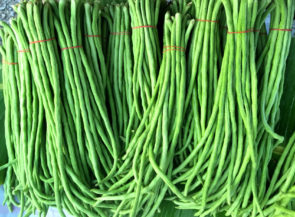
Yardlong beans (for real Surinamese people, it’s still kouseband without the n)
Very long green beans, not cut into small pieces as in the roti, to wish your parents a long life.
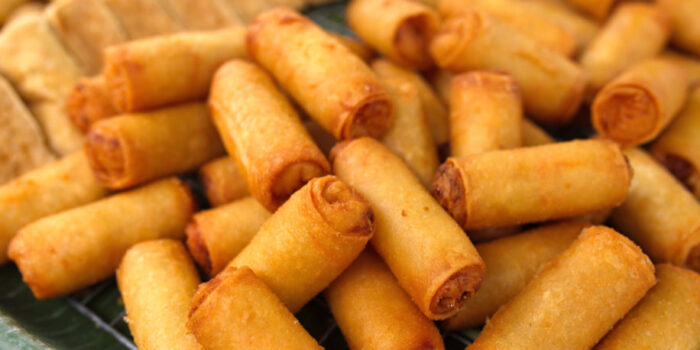
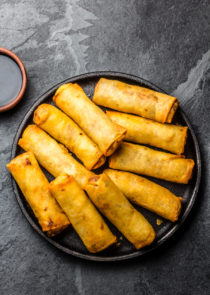
Spring rolls
Come on, you see little gold bars here too, right?!
Also read:
- Bye-bye Foe yong hai: corner Chinese restaurants are disappearing
- This ingredient makes every dish taste authentically Chinese
- Is this Chinese? Well, no


