



Albert Heijn sells plant-based ‘butter’ with ‘source of fibre’: what does that mean?
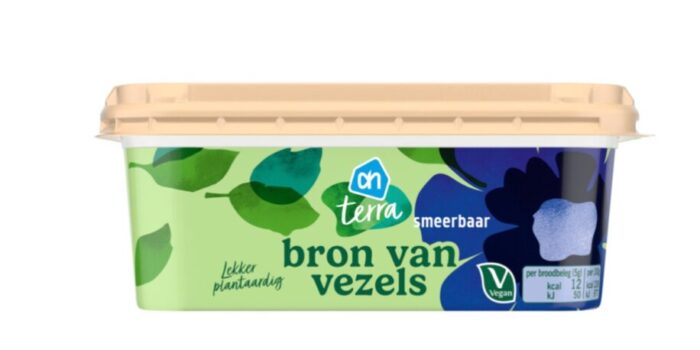
Albert Heijn’s Terra range is a line featuring more than 200 plant-based products. This also includes a selection of plant-based butters, spreads and margarines. One caught our eye: AH Terra Plant-Based Spread, source of fibre. Clever marketing trick or genuinely a healthy product?

A happy belly comes from eating enough fibre. According to Het Voedingscentrum, we get it best from wholegrain products, vegetables, fruit, pulses and nuts. “Adult women are advised to consume at least 25 grams of fibre per day, and adult men at least 30 grams per day,” its website says. So you have to make an effort. Isn’t it ideal, then, that we can spread something like AH Terra Plant-Based Spread on our bread, which turns out to be a ‘source of fibre’?
Plant-based ‘butter’
To clarify: we are not talking about butter. That is not what this Terra product is called on the packaging, either. Butter is churned cream from milk, so it cannot be plant-based, unlike this Terra product. It is a plant-based product that you can spread on your bread for some extra flavour or to help your sprinkles stick better. Just like ‘real’ butter, in other words. Products like these are generally not known as genuine sources of fibre. Yet AH Terra Plant-Based Spread contains no less than 4.8 grams of fibre per 100 grams of product. So where does that fibre come from?
Fibre-rich E-numbers
When you look at this product’s ingredients list, you immediately see a list of E-numbers. Well, that does not really surprise us with supermarket products. If you want E-number-free butter, you can almost only rely on a farmer. But then you do not have a plant-based product… And for vegans, that simply is not an option.
There is one E-number from which AH Terra Plant-Based Spread most likely gets its high fibre content. That is E-number 402: the stabiliser potassium alginate. In a list of E-numbers from A Healthy Life, you can see that this is the ‘salt of alginic acid’. Alginic acid is a thickening agent extracted from seaweed. If you look into that more deeply, you discover that it is a natural polysaccharide. The cell walls of seaweed contain the structural polysaccharide cellulose (hey, we know that!) and that contains dietary fibre. In addition, the product contains corn starch, which according to Het Voedingscentrum contains 0.3 grams of fibre per 10 grams.
The packaging does not state how much corn starch and potassium alginate this AH Terra Plant-Based Spread contains. But these ingredients would then have to be the ‘source of fibre’.
Clever marketing trick
Is Albert Heijn saying something that is not true? No. It is even allowed to make this claim. Producers may put ‘source of fibre’ on the packaging if the product contains at least 3 grams of fibre per 100 grams. With 4.8 grams of fibre, Albert Heijn meets this threshold. And is the product bad? Well… The fact that it contains palm fat, which contains a lot of saturated fat and is not exactly good for nature, does not really help. It is also a fairly highly processed product when you look at the ingredients list with its E-numbers.
Even though Albert Heijn is allowed to make the claim ‘source of fibre’, it is of course misleading. It is printed huge, in bold letters, on the packaging. As if this were the way to get more fibre. Sure, you do get some fibre, but the amount is negligible. It smells like a clever little marketing trick, let’s be honest. Do not expect this to be the magical miracle cure that will relieve your constipated bowels or bloated stomach. For that, you are better off using your common sense and eating genuine sources of fibre.
Also read:
- 10 downright ridiculous supermarket products
- 15 packages that are so misleading, it is almost criminal
- Spreading too much butter back on (with breadcrumbs). Why??
Sources: Het Voedingscentrum, A Healthy Life, Max Vandaag, zaailingen.com


