


Guide: The Vietnamese Pantry
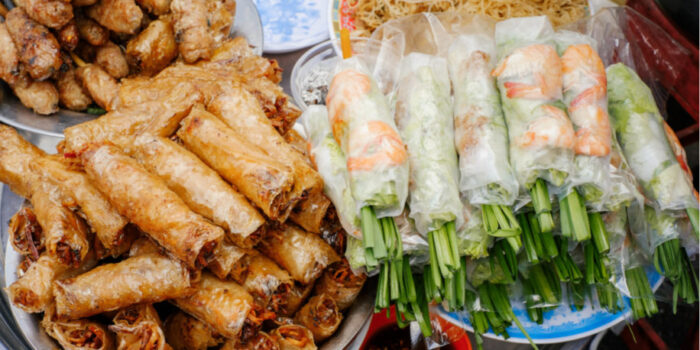
Diving into a new cuisine can be overwhelming. Recipes call for spices you don’t have at home, or combine them in a new way. Once you have the perfect pantry stocked, you’ll be whipping up those new recipes in no time. I’m happy to help you get started, this time with the basics of Vietnam.

Vietnam borders China to the north, Cambodia and Laos to the west, and the South China Sea to the east and south. All these neighboring countries have influenced Vietnamese cuisine in their own way. In addition, Vietnam was part of French Indochina for a long time, and the influence of French cuisine is still clearly visible.
Vietnamese cuisine
Is characterized by the Buddhist five-element philosophy, in which a flavor is linked to an element of nature: sour for wood, bitter for fire, sweet for earth, spicy for metal and salty for water. The idea is that every dish should have a balance between these elements and flavors.
Another characteristic is the use of contrasting textures, such as soft and crunchy. Think soft rice noodles and pork with crunchy vegetables and fried onions. If you really want to master Vietnamese cuisine, the list of ingredients is enormous. But with the list below, you’ll already be well on your way.
These ingredients are essential for a Vietnamese pantry:
Fish sauce
What olive oil is in Italian cuisine, fish sauce (Nuoc Mam) is in Vietnam, Thailand, Laos and Cambodia. It is made by pressing, salting and fermenting anchovies, and can be used in all kinds of ways. In broth, diluted with water and sugar as a dipping sauce, or mixed with palm sugar as a glaze over meat. Doesn’t it make everything taste fishy? Not at all. It has more of a nutty, umami flavor. Delicious with your bun cha.
Oyster sauce
Traditionally, oyster sauce is made by cooking oysters in their shells in water and mixing them with sugar and cornstarch. Quite an expensive affair, so oyster extract is usually used nowadays. The result remains more or less the same: a thick sauce that is both sweet and savory, perfect for stir-fries because its flavor spreads well, counterbalances bitter leafy vegetables and adds a pleasant sweetness to meat. By the way, you’ll want to make these 4 Vietnamese dipping sauces yourself right away.
Chicken stock powder
An indispensable flavor enhancer in Vietnamese cuisine, alongside fish sauce and soy sauce—yes, this cuisine uses it too. Don’t be mistaken; this powder cannot be replaced by the stock cubes sold in supermarkets here. Those cubes do not have the same composition as this chicken stock powder. Available at Chinese supermarkets.
Shrimp paste
Also known as trassi in the Netherlands. Although it is never used in large quantities, it is used fairly often in Vietnamese cuisine, so it is always handy to have shrimp paste at home. The paste is made from fermented shrimp and salt and gives your dish a strong, umami flavor. A small spoonful is enough to make all the difference in your soup or dish, and you can also use it to pickle vegetables.
Jasmine rice
To counterbalance all those sour, salty and umami flavors, fragrant jasmine rice is often served in Vietnamese cuisine. When buying it, make sure you choose jasmine rice from Thailand or Vietnam—it tastes best.
Coconut water
We’ve written about it before: coconut water is not only delicious to drink, you can also cook with it very well. The juice from young, green coconuts is often used in stews. It makes the meat more tender and gives the dish a very subtle sour and sweet flavor.
Pickled vegetables
Do chua (literally: sour things) can be found in every Vietnamese household. Anything goes, but the most commonly used vegetables are cabbage, carrots and cauliflower. The sour and slightly sweet flavor of the pickled vegetables adds a lovely freshness to the salty and spicy flavors of many Vietnamese dishes. Another bonus: they’re very easy to make yourself.
Rock sugar
Instead of refined sugar, Vietnamese cuisine often uses rock sugar. It adds a nutty sweetness and is mainly used in broths for noodle soups such as pho and bun bo Hue—the lesser-known sibling of pho made with oxtail.
Sriracha
Ready-made chili sauce and indispensable in a Vietnamese kitchen cupboard. It is poured over all kinds of dishes, whenever and wherever. It could practically be our editorial team’s lunch.
Sambal oelek
Although you’re served sriracha everywhere, when it comes to cooking, sambal oelek is the go-to sauce. It has a coarser texture and a strong, spicy flavor that pairs well with fish sauce, rice and pickled vegetables.
Rice vermicelli
Indispensable in Vietnamese cuisine: rice noodles and their thinner variant, rice vermicelli. Many Vietnamese dishes are more or less the same, with rice simply replaced by rice vermicelli (bun in Vietnamese). The rice “vermicelli” fills things out a little without making your dish too heavy.
Fresh herbs
Sure, it’s a shame they don’t keep forever in your pantry, but fresh cilantro, spring onion, Thai basil and mint are flavor enhancers found in almost every Vietnamese soup. Or what about Vietnamese chicken curry, Vietnamese savory pancakes and fresh spring rolls? Fresh herbs add that little extra flavor to a dish, plus the stems provide a lovely crunch.
Rawit
Although Vietnamese food is nowhere near as spicy as Korean, Thai or Indian food, small chilies are often served with meals. Sometimes sliced in a bowl on the side, sometimes mixed into a dipping sauce. In many Vietnamese households, people simply keep a plant from which they pick these chilies, called rawit, whenever they need them. In the Netherlands, you can buy them at Asian supermarkets and sometimes at regular supermarkets too.
Vietnamese pepper
Black pepper from Vietnam is slightly different from the black pepper we know: it has a hint of sweetness and sourness. In Vietnam, people like to sprinkle it generously over everything, but be careful: it’s still pepper. In the Netherlands, you can simply buy Vietnamese black pepper at Albert Heijn.
Cardamom
Along with star anise, cloves and cinnamon, cardamom is an indispensable spice for your aromatic Vietnamese soup base. Prefer a milder cardamom flavor? Then look for green cardamom.
Lemongrass
Walk into a Vietnamese kitchen and there’s a good chance you’ll find lemongrass. If it isn’t fresh, it will be in a jar. This refreshing herb is mainly used—along with fish sauce, sugar and pepper—to braise meat, giving your dish that delicious fresh citrus flavor.
Lime
Whatever it is, virtually every Vietnamese dish is served with a wedge of fresh lime. Whatever is in front of you, squeeze a little lime over it and a whole new world will open up.


