


Organic and free-range eggs are misleading: supermarkets must adjust packaging
Food watchdog Foodwatch has been vindicated by the Dutch Advertising Code Committee in its fight against misleading packaging for organic and free-range eggs. The committee concluded that Albert Heijn, Aldi, Lidl, Plus and Wegman (at Dekamarkt) violated the rules by misleading consumers about laying hens’ access to the outdoors. Due to avian flu, a housing order was in effect, meaning the chickens had been kept indoors for months.

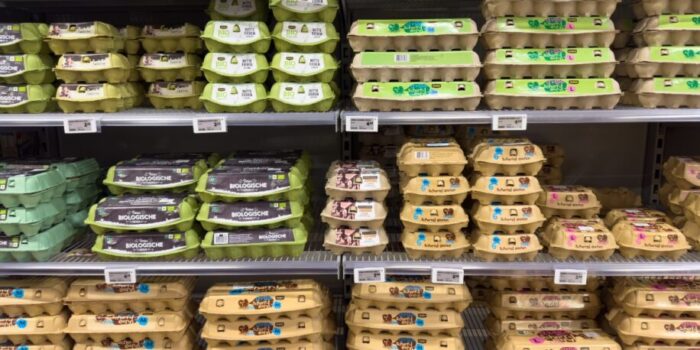
The producers portray an unrealistic picture on their egg cartons and online of the lives of laying hens during the housing order. They also fail to state on the carton or shelf that the hens do not actually have access to the outdoors. Anke Bakker of Foodwatch says: “Consumers who consider it important to buy eggs from chickens that have had a better life, and are happy to pay a little more for them, have not been informed that the eggs come from chickens that have been kept indoors for months. Only with honest information can consumers make an informed decision about which eggs to buy, or whether to avoid them altogether.”
Idyllic advertising
Foodwatch had already complained in March 2024 about idyllic advertising depicting hens enjoying free-range access on egg cartons during a housing order. In reality, many chickens had been required to stay indoors for months because of the persistent avian flu (until 24 April 2024, when the Dutch government fully lifted the housing order). Foodwatch therefore filed complaints about text on the egg cartons such as “During the day, they enjoy the free-range area where they can have a wonderful time” and illustrations of chickens freely scratching around in a flower-filled meadow.

Adjusting packaging
The Dutch Advertising Code Committee considers the egg-carton packaging at five supermarkets misleading. The Committee has therefore asked the supermarkets “not to advertise in such a manner again”. At Aldi, Plus and Wegdam (Dekamarkt), the issue concerns free-range eggs, while at Lidl it concerns organic eggs. Albert Heijn violated the rules for both free-range and organic eggs. These supermarkets will have to adjust their egg packaging whenever a new housing order is introduced. There is still a 14-day objection period during which the supermarkets can challenge the rulings. If they do not, the decision will become final.
In August 2023, under pressure from the agro-industrial sector and supermarkets, the European Union decided that eggs from chickens kept indoors may be sold indefinitely as ‘free-range’ eggs, including during lengthy housing periods. Previously, these eggs could be sold as free-range for a maximum of 16 weeks, after which they had to be labelled as barn eggs. Foodwatch considers this a disgraceful decision. Foodwatch also noticed that, in addition to the permitted misleading designation, producers voluntarily added further false claims and inaccurate illustrations to the egg cartons. The same was found to be true of organic eggs.
Misleading egg cartons
Foodwatch filed more complaints about misleading egg cartons. The complaints against Blije Kip (outdoor, organic and free-range eggs), Jumbo (free-range and organic eggs) and Albert Heijn’s Rondeel were rejected. Foodwatch is objecting to the rulings concerning Blije Kip and will further examine the other rulings to determine possible next steps.
Foodwatch advocates for animal-friendly livestock farming and believes consumers must be given structurally honest information about how animals are kept. The committee’s rulings are an important step towards transparency and honesty for consumers, enabling them to make well-informed choices.
Also read:


