


Q&A with the guys from Chin Chin Club
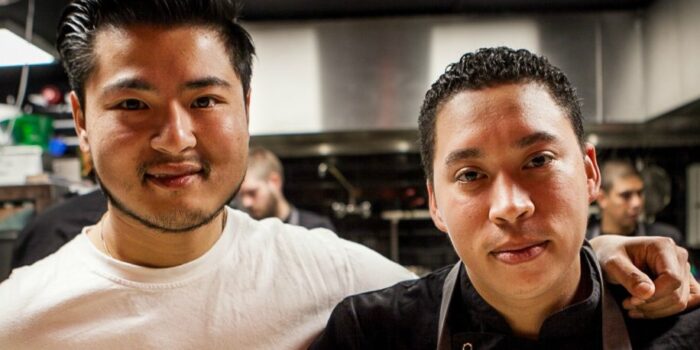
The Chin Chin Club recently opened on the Rozengracht in Amsterdam. You can sing karaoke to your heart’s content, play table tennis and dance until deep into the night – on the dance floor in front of the DJ booth or in the Dance Dance Revolution room. And, most importantly, you can eat fantastic food there. FavorFlav interviewed co-owner Danny Lee and head chef Stanley Schiltmeijer.

Danny’s parents have owned a Chinese restaurant since 1991: Fook-Sing on the Molukkenstraat in Amsterdam. His passion for the hospitality industry was therefore instilled in him from an early age. Lee has always worked in hospitality, first in his parents’ restaurant and later in major establishments in London and Hong Kong.
Stanley’s mother also had her own restaurant. After working there, he cooked in the kitchens of the Krasnapolsky and at Visaandeschelde, among others.
Which food trend should we put an end to immediately?
Stanley: ‘I don’t think we should put an end to any food trend. Every trend is important to the hospitality industry; trends are precisely what you can play with. So I think trends are a good thing – in fact, I think you need them. Vegans should also come to your restaurant and post photos on Instagram. You have to respond to that.’
Danny: ‘I think the opposite. A trend should never be the foundation of your business. You shouldn’t use a trend to start something; you should start something out of passion. If it subsequently becomes a trend, of course, that’s a nice bonus, but basing your concept on a trend is not a good idea, in my opinion. Trends disappear again too, you know – hopefully your restaurant won’t, haha.’
Most memorable food experience?
Stanley: ‘Simply at home, with a plate of my mother’s food in front of me. My mother often cooked Indonesian, Chinese, Surinamese or Japanese food. I was allowed to watch while she cooked, but not help. I didn’t want to anyway. My mother had a restaurant and was therefore working a lot, so I associated cooking with something unpleasant: a mother who was away from home. It wasn’t until my mother’s restaurant was nearly bankrupt that I had to help in the restaurant kitchen. That’s where my passion for cooking began. From that moment on, I never did anything else.’
Danny: ‘My most memorable food experience was in Hanoi, in Vietnam. I was looking for food with four friends; we were hungry. After wandering around for a while, we walked into an alley where an old woman was sitting with a cutting board on her lap. A pile of raw meat on one side and a pot of soup on the other. She made Vietnam’s most famous dish for us: pho. It was unbelievably good. The circumstances were strange, but everything was just right. A bowl of the best pho ever, under the light of fluorescent tubes in a dirty alley. So cool. You don’t always have to be in a fancy restaurant for good food.’
Favorite drink?
Stanley: ‘Dawet, a Surinamese drink with coconut and rosewater. You can buy it at Surinamese takeaways. I drank a lot of it when I was growing up, so it has nostalgic value for me. I made a dessert with it at Chin Chin, a rosewater panna cotta. The drink is actually already a kind of base recipe for panna cotta: add rosewater syrup and gelatin, and it’s ready.’
Danny: ‘Sparkling water.’
Indispensable kitchen gadget?
Stanley: ‘A thermal blender. You can determine the texture of whatever you make yourself with it. You can make anything with it, from mayo and hummus to Bavarian cream and curd.’
Danny: ‘A Chinese cleaver. Filleting, slicing, chopping – you can do everything with it. You no longer need four different knives. It’s the first knife I learned to work with. I still use it.’
https://www.instagram.com/p/BW9vDu1lmnF/
What will you never eat again?
Stanley: ‘Mealworm. I always want to try everything, so when I was in Thailand, I ate these little creatures. The texture is especially unbearable: grainy, floury, cornflour-like sludge. It reminds me of pus. Absolutely disgusting. Never again.’
Danny: ‘I’ve eaten scorpion twice, once in Thailand and once in China. The ones in China were delicious, deep-fried until very crispy, a bit like crisps, really. But I won’t eat the ones in Thailand again. They had an unpleasant, firm, liver-like texture and tasted mainly very metallic and foul.’
Which country is your favorite when it comes to food?
Stanley: ‘Thailand (apart from the mealworms, that is). I traveled from Bangkok first to the south and then all the way north, to Chiang Mai. I thought the street food throughout the country was fantastic. Narrow openings through which you could see the most beautiful fish available – amazing.’
Danny: ‘I have a favorite food city: Hong Kong. You can eat anything there. I lived there for eight months, so I knew the city well and exactly where to go. Japanese food is truly excellent there, and classic Chinese food, of course. Virtually all Asian cuisines are superb. You can also eat very good French food there, but it’s really expensive. All the wonderful French products, from Bresse chicken to Maine lobster, are available in Hong Kong. Not very sustainable, but delicious. Prices range from five euros for a bowl of good noodle soup to five hundred euros for superfine dining.’
What should everyone try at least once?
Stanley: ‘Oysters with rendang foam, which I make at Chin Chin Club. The combination seems conflicting at first, but the lemongrass and kaffir lime leaves in the rendang make it work. These fresh flavors go very well with the oyster. Add the crunchy seaweed tempura and you have a perfect match.’
Danny: ‘A combination of tripe and brisket; it’s a dish from the Chinese province of Sichuan. The hot pepper, the chewy texture of the tripe and the brisket soaking up all the juices make it incredibly delicious. You can eat it well at restaurant Mandarin on the Rokin in Amsterdam. And at restaurant Sichuan on the Warmoesstraat. People should eat more Sichuan food in general. Especially if you like offal – duck tongues and pig’s ears, for example – it’s just so good.’
What is the best supermarket product?
Stanley: ‘I prefer going to the market, to be honest. Well, I don’t know, toilet paper and toothpaste, I suppose.’
Danny: ‘I really hate supermarkets. I’d rather go to the butcher, cheesemonger or baker. But if I have to go there anyway, um, sparkling water.’
What is still on your food wish list?
Stanley: ‘I’d really like to go to Japan to eat the freshest fish there. Yes, that country is definitely number one. I think it would be absolutely amazing.’
Danny: ‘Yes, same. Japan – I have to go there.’
Which cookbook should everyone have on their shelf?
Stanley: ‘A Day at elBulli. A beautiful book that tells the story of Ferran Adrià, in my eyes the best chef in the world. How he can create ten different textures from a tomato… Wow. If you really want to be a good chef, you have to read this book.’
Danny: ‘Escoffier. A classic. His influence on French cuisine is still visible today. All the basics are in here. A very important book. Ratatouille is my favorite film, by the way; everyone should see that too. Dream big is the message of the animated film. And I wholeheartedly agree.’
What do you like to make at home when you want to eat quickly and well?
Stanley: ‘A toasty with cheese, sambal badjak and avocado. I fry it in a pan with lots of butter. And my Filipino girlfriend always makes rice with corned beef, onion, garlic and corn for me. So delicious.’
Danny: ‘Instant noodle soup from a packet, from the Nissin brand. Chicken flavor. With Spam (a type of luncheon meat, ed.) and a fried egg on top. When I come home from a festival, when I have a hangover, whenever – this is the solution.’
Which dish do you have no self-control around?
Stanley: ‘Beef ho fun from Nam Kee. You can wake me up for these rice noodles with beef.’
Danny: ‘The black bean ribs when my father makes them. I just keep eating them. He fries black beans, garlic and chili pepper. He marinates the ribs in that with a little olive oil and Chinese cooking wine. He lets this rest for half a day. Then he steams it for an hour, adds spring onion and digs in.’


