



‘Extra long delicious’ and ‘fresh for longer’ bread: what does that actually mean?
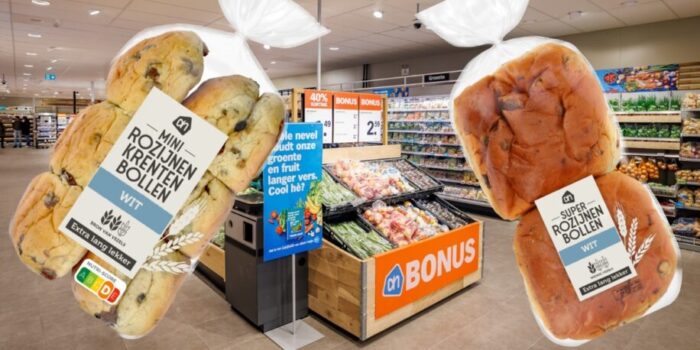
For me, nothing beats a fresh loaf of bread from the bakery. The kind of loaf that’s still a little warm because it has just come out of the oven, with a delicious crunchy crust. Still, I might be better off buying my bread at the supermarket — at least, if I’m to believe the supermarkets themselves. They sell plenty of loaves that are ‘extra delicious for longer’ and ‘fresh for longer.’ Sounds good, you might think. But what does it really mean?

The Keuringsdienst van Waarde wondered about this too and made an interesting episode about it. First, the question arises: what does ‘fresh’ actually mean? When, or for how long, is something fresh? There are no fixed guidelines for this. The baker who speaks in the episode offers a little more clarity: once bread comes out of the oven, it stays fresh for 12 to 24 hours. After that, retrogradation takes place. This is a process in which starch returns to its natural form, after which the bread falls apart or becomes hard. At that point, it is officially no longer fresh bread.
Flour from the mill and from the factory
Bread is made from flour. But not all types of flour are the same. The flour used for supermarket bread is most likely not the same as the flour a baker uses for their bread. Miller Erik Dudink, baker Tim van Dalen and food technologist IJsbrand Velzeboer explain this in the episode. Dudink says that at his mill, he grinds wheat between millstones into whole-wheat flour. Bread baked with this flour keeps for a maximum of two days.
Flour mills do things differently. There, they take seven steps to produce whole-wheat flour. Something happens at each step, but perhaps the most important is the one in which the wheat germ is removed from the flour. The wheat germ is then processed: it is heated. After that, it is put back into the flour. The heating is done to prevent the bread from quickly deteriorating in quality. But heating also causes all the flavor compounds to disappear. By temporarily removing and processing the germ, you make the bread last longer, but also make it less flavorful.
Enzymes
And that’s not the only thing that might allow you to eat that Albert Heijn bread or those Aldi rolls for up to a week. Turn over the packaging of such ‘fresh for extra long’ loaves and take a look. Chances are you’ll see the word ‘enzymes’ on it. Enzymes are part of bread improver: BVM. Bread manufacturers also use this to make their loaves last longer. These enzymes work like tiny scissors. They ensure that starch breaks down, making it harder for it to crystallize, so your bread also becomes hard less quickly.
Genetically modified little loaf
Not surprisingly, manufacturers keep tight-lipped about those enzymes. Still, Keuringsdienst van Waarde discovered where the enzymes come from. Bioengineer Charlotte Koster pulls back the curtain a little and explains that the enzymes come from bacteria and fungi. Bizarrely, bacteria are often genetically modified to produce those enzymes on a large scale. Think of it as a kind of chip added to the bacterium, making it produce a shitload of enzymes.
But, um… Genetic modification in food isn’t allowed at all, right? ”No,” says Koster, ”but the genetically modified bacteria themselves don’t end up in the food either.”
Supermarket vs. bakery: your choice
In the episode, you see the difference between an altered loaf and a fresh loaf. The altered loaf comes out of the oven twice as high. After four days, it still looks exactly the same and tastes just as good, while the fresh loaf is rock-hard and moldy. In principle, you can eat supermarket bread that stays fresh longer without any problem. But the very best bread without additives really does come from the bakery. So make sure you know what you’re bringing home.
(Incidentally, if you’re a fan of supermarket bread: this supermarket has the best loaves.)
Also read:


