



10x important food safety tips in a row
Are you someone who lives a little dangerously on the edge when it comes to food safety? Have you long since stretched the three-second rule to five seconds, and then counted nice and slowly too… Or do you prefer to scrub every cherry tomato with a color-coded sponge before eating it? Most people choose the middle ground, and when it comes to some things, it isn’t entirely clear to everyone what is or isn’t intended. That’s why we’ve put together these food safety tips:

Because food safety facts (try saying that three times quickly) are useful to know, and we’re happy to list a few more for you.
Why you shouldn’t shower chicken
You should NOT rinse raw chicken under the tap. You may never have heard of this at all, but apparently there are people who do it. Bad idea. Instead of removing the bacteria you think are there, you splash them all over your faucet handles, countertop, and everything on it. In the end, you’re much more likely to get salmonella than if you had simply put the chicken in the pan or oven and then washed your hands.
The three-second rule is nonsense
The things we tell ourselves so we don’t have to waste a precious piece of fried chicken, or a delicious bagel, or a few drunken strawberries – it’s almost endearing. “If I’m quick enough, it doesn’t matter”… Unfortunately. Of course, it’s up to you, but the fact is that bacteria can attach themselves to your food immediately upon contact. I mean, you might as well run outside and lick a paving stone.
Leftovers of leftovers
If you have some food left over from a meal and store it (good for you, food waste is stupid), you need to reheat it thoroughly and eat it within three or four days. Disease-causing bacteria operate invisibly. So even if you can’t see that anything is wrong because there are no visible signs such as mold and it doesn’t even smell strange, you can still get food poisoning from it. You can’t reheat leftovers a second time either.
The butter paradox
I personally have a little trouble with this one, even though I’m pretty germophobic. You really should store butter in the fridge. Especially if you’ve managed to get your hands on such a delicious raw-milk variety. But surely you don’t want to get up half an hour earlier just to let a lump of butter come to room temperature so you can spread it?! Unfortunately, the safest place for butter is in the fridge…
The vegetable drawer is a disgusting drawer
The vegetable drawer, which some people on Twitter are already campaigning to rename the beer drawer so no one has to feel guilty anymore, turns out to be a significant potential source of germs, according to research. Not everyone cleans that compartment regularly, even though you really should, using hot water and soapy water. Don’t feel like it? Just think of all those microscopically small creatures on that piece of cucumber you were just planning to drag through your homemade hummus.
Your cutting board is a bacterial paradise
Not nice to hear either. But your beloved wooden cutting board can be a breeding ground for bacteria, and you really need to keep it clean. Plastic cutting boards are also often replaced too infrequently, allowing germs to settle into the grooves these things inevitably develop. Always keep them as clean as possible and maintain them properly (here you can read how to care for a wooden cutting board, and here you can read more about plastic cutting boards).
White chocolate (that should be brown)
Time for some good news! That chocolate with a white coating? Not a problem at all! Just eat it. The ‘phenomenon’ is called chocolate bloom, and here we tell you more about chocolate bloom. One thing that can help prevent it is knowing how best to store chocolate.
Only double-dip when you’re alone
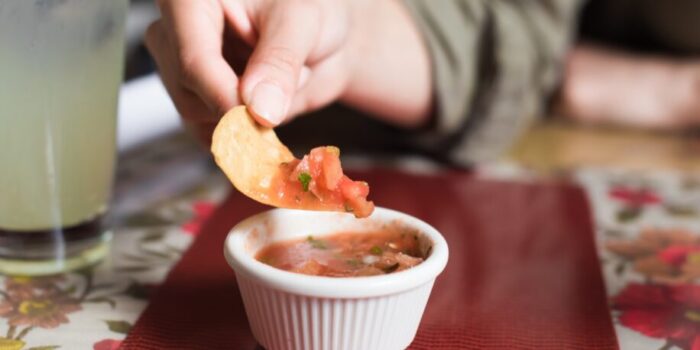
We can safely say that 2020 made everyone more aware of other people’s saliva. If we ever look back on corona (as a months-long nightmare we just couldn’t wake up from), I don’t think we’ll be able to imagine that people once casually dipped a tortilla chip into salsa (or classic guacamole), took a bite, and then dipped the remainder of the chip into the sauce again. And that the entire group did the same thing. Or worse, double-dipped in the tapenade sample bowl at the market! I think the days of sample bowls out in the wild are numbered anyway.
Secretly snacking on cookie dough
I can hear myself saying it: don’t snack on cookie dough because it contains raw egg! Makes sense, right? Because salmonella is not something you’d wish on anyone. But in 2017, there was a huge commotion in America because of E. coli infections (that’s the ‘poop’ bacterium) caused by: uncooked wheat flour. All those fingers in the chocolate chip cookie dough; it took a major investigation, and eventually millions of kilos of flour had to be recalled. So it’s not only raw eggs in dough or batter that can make you ill—flour can also be the culprit. In any case, your intestines aren’t happy when they have to process ‘raw’ flour, which is why you should always cook the flour in a roux thoroughly in butter before adding the milk.
Cook minced meat thoroughly
The Netherlands also recently experienced an E. coli problem when it turned out that the bacterium was present in certain hamburgers and sausages from Albert Heijn. Minced meat was not among the contaminated meat products. Even so, it’s always a good idea to cook minced meat all the way through and make sure there are no pink pieces left. Only certain cuts of meat, such as steak or pork tenderloin, are suitable for serving pink (or rare, in the case of steak), but processed meat should in principle always be cooked completely through to be safe to eat.
Also read:
- 7 tips for cooking safely
- These are the 7 disgusting sins that so many people are guilty of
- These are the 10 things you’ll most want when you’re just starting to cook


