


I baked a sourdough loaf – and now I want to warn you

During the coronavirus lockdown, the Dutch working from home threw themselves en masse into jigsaw puzzles, banana bread, yoga videos and baking sourdough bread. I’m always a little slow to catch on to new trends, so now that the restrictions are gradually being eased and vaccination is in sight, I thought I’d bake one of those loaves too.

I finally understand why sourdough is such a success when you don’t have much excitement in your life otherwise. Because honestly: the suspense created by a fermenting jar on your extractor hood is hard to compare with anything. First, you innocently click yourself into a maze of sourdough videos, then you scour town and country for the right flour, and after that you spend a week at the mercy of the whims of particles floating through your kitchen—only the right particles, of course, and definitely not the wrong ones.
I check roughly every hour to see whether there’s any sign of life yet. Let me tell you all about my quest, so you can benefit from it. Or laugh at my attempts, because after more than a year cooped up in your house and garden, you’ve become a fully fledged sourdough tamer, which is of course also possible.
A jar full of mould
So sourdough starts with a simple little dough: just mix flour and water, put it in a jar and you’re done. Sounds manageable, but that’s when it begins. Which flour? Organic rye flour is preferred, so you have to try to find some somewhere. Spoiler: Deen supermarket doesn’t have it. The jar has to be impeccably clean and, if you stick to the prescribed amount of water, it doesn’t look like the pictures on the internet but more like a little lump. Is that right?
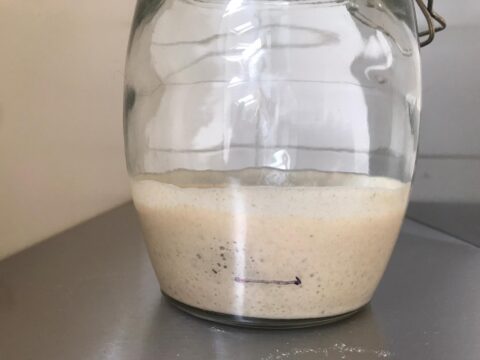
Earlier experiments ended with a jam jar full of horrific blue-black mould, but this time it seems to be going better. After five days of taking the dough out of the jar, throwing part of it away, replenishing part of it with that rye flour and water, and putting it back, I’m cautiously beginning to see something happen. Tiny bubbles in the dough, it doubles in volume and there does indeed seem to be life developing in the jar.
Timetable and planning
Ready for the next step: real sourdough bread. Fortunately, the internet is full of recipes, complete with timetables. And if you’re thinking now: a bit excessive, then you’ve never baked sourdough bread. The project starts the evening before you want to bake, by making a starter. After twelve hours of fermenting at room temperature, you can add the flour, and the water, and then a programme of rising, kneading, more rising and more kneading begins.
You can’t just get the flour for a loaf like this at the supermarket either (if I’m wrong, I’d love to hear it), and I also need a special proofing basket, so I order one online.
Bad words
After a morning and afternoon under a strict regime of kneading and rising, I can lower my dough into the floured proofing basket and gently cover it there with a drab linen cloth that comes with the basket. Let it rise for just over two hours and 37 minutes, and then I can turn it onto the baking sheet in one smooth movement.
Unfortunately, my pampered dough sticks to the basket on all sides, so quite a few bad words were uttered. Ten euros’ worth of flour! Twenty euros for the proofing basket! Two days of messing around! And then the result looks like a pile of spaghetti! I fold it back into a little ball as best I can, slide it into the piping-hot oven and hope for the best.

I want a drink on a terrace
The result: delicious bread. In a bizarre shape. I’m already working on the next loaf, because that one has a preparation time of no fewer than four days. And I’m going to grow sunflowers in the proofing basket.
Also read:
- Spreading too much butter back on with breadcrumbs: why?
- How to turn your baguette and herb butter into a really tasty snack
- Still have time to spare? Go all out on your sandwich


