



The story behind the iconic pasta dish cacio e pepe
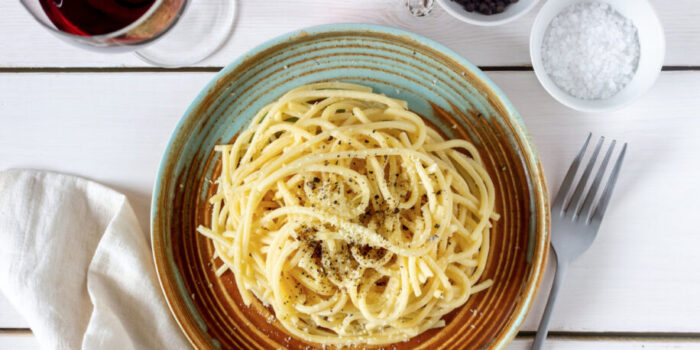
Cacio e pepe (which means cheese and pepper in Roman dialect) is one of those wonderfully simple pasta dishes that you can hardly not love… So cheesy, so peppery, with those perfectly cooked long strands of pasta completely coated in the incredible emulsion the sauce becomes when you melt the cheese perfectly with a little pasta water; I’m literally salivating a little right now. This is the story behind this brilliant dish…

Because you already knew from us that it really belongs in everyone’s basic repertoire. And that sometimes you’re allowed to riff a little irreverently on the standard recipe: go for it! But once you know where this dish originated, and how it’s at its purest and most delicious, you’ll want to make it that way straight away.
Long ago, in the mountains…
… Sheep grazed on the grasslands between the Apennines in Northern Italy. And while it’s romantic to believe that the shepherds, with the dried pasta they brought along (because it kept well) and a few peppercorns, cheerfully put the dish together in a green meadow using cheese from their own sheep, it’s more likely that it originally was the simple staple meal of the families who worked in the mines and factories, and led a hard, demanding urban life in the Lazio area around Rome. Sauces such as carbonara and amatriciana, all figureheads of cucina povera (poor people’s cuisine), probably originated here too.
Bring some pasta, then
Even the pasta was most likely a later addition. Although sheep’s cheese in the region had been mentioned for centuries, as had the cured pork in carbonara and amatriciana, they only became common in a pasta dish around 1800. This was roughly (and only) the moment when pasta, introduced through the ports of Venice, reached Rome and began gaining popularity there. Italians leave no room for doubt, by the way: cacio e pepe calls for spaghetti, or better still tonnarelli (also a long strand pasta, made with egg).
Pecorino or Parmigiano…
Purists swear by Pecorino. This sheep’s cheese, in its more mature form sharper and saltier than Parmesan, belongs in the original recipe and naturally becomes milder thanks to the pasta water. Still, many people replace some or all of the Pecorino with Parmigiano Reggiano. That makes it gentler, and according to some die-hard fans, ‘more suitable for children’. Three-Michelin-starred chef Massimo Bottura***, however, advocated a version made with Parmigiano Reggiano alone, to give a boost to the Emilia-Romagna region, which was hit by a major earthquake in 2012. And if Massimo Bottura (who also brought us brilliant pesto!) does it, no one will hold it against you…
Hot stuff
You’re supposed to briefly toast the black peppercorns in a dry pan, then crush them coarsely in a mortar. So don’t grind them coarsely or finely from the mill, and even if you like it: white peppercorns no, black peppercorns yes. In this case, anyway.
From poor people’s food to luxury fare
Cacio e pepe was once a meal for the poorer population. By now it has almost achieved cult status, and Michelin-starred restaurants have embraced it too. Don’t be fooled by how simple it looks, or by how few ingredients you need. It often takes some practice to master how to prevent the cheese from clumping, leaving you with a pan full of annoying strings and lumps. At the very least, make sure the cheese is grated ultra-finely with a Microplane, and mix it carefully with a little more pasta water at a time. But once you reach your cacio e pepe peak, you’ll have one of the most heavenly plates of pasta in your hands…
Read also:
- Recipe: Cacio e pepe
- Handy list: these cheeses are safe to eat when you’re pregnant
- 11 things that will keep for at least two weeks in your fridge
Source: BBC


